350 India’s Youth Movement For Climate Sanity Is Taking Flight
Author:
First published in Sanctuary Asia,
Vol. 34
No. 2,
February 2014
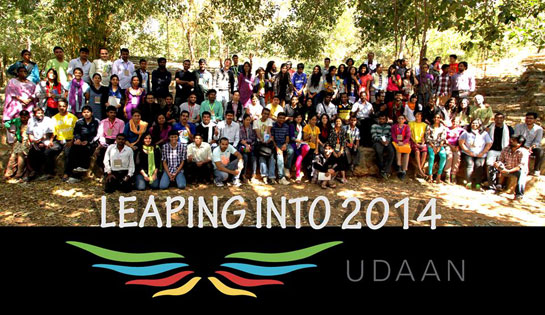
350 India is the Indian branch of 350.org, a global organization that is building a grassroots movement to address the challenge of climate change. Udaan 2013 was designed to help youth leaders take the climate and environmental movement in India to a new level of activism and effectiveness. Participants and speakers came from all parts of the country, and represented “urban and rural areas, rich and poor, privileged and underprivileged, activists and non-activists, and leaders and soon-to-be leaders," according to 350 India.
According to meeting organizers, “India's rapid industrialization through its dependence on fossil fuels is adding to the problem of climate change which, historically, we contributed little to. Now climate change is an issue that we simply cannot escape! All nations need to act and India can be a true leader in showing the world how development can take place through clean, decentralized, renewable and sustainable sources of energy. As young people, our role in urging our Government and fellow citizens to take action is greater than ever before."
The scope of Udaan 2013 was ambitious: participants learned about campaigning, movement building, and organizing; they discussed the politics and policy of environmental issues; they learned about the power of media and communications to engage fellow citizens; they evaluated how change happens, and how they can help to transition India toward a safe, clean energy future.
Speakers included writer and activist Nithyanand Jayaraman, who discussed non-violent direct action and creative activism, and Deepa Gupta from Jhatkaa and Katyayini Chamaraj from CIVIC, who shared insights about planning campaigns. Shankar Sharma spoke on energy security in the context of climate change. Local people from Chhattisgarh who are fighting coal mining shared news of their struggle, and the ways in which their communities are suffering the devastating health and environmental effects of coal. Others presented in-depth talks on the science of climate change, and on the use of social media to communicate the movement's plans and needs.
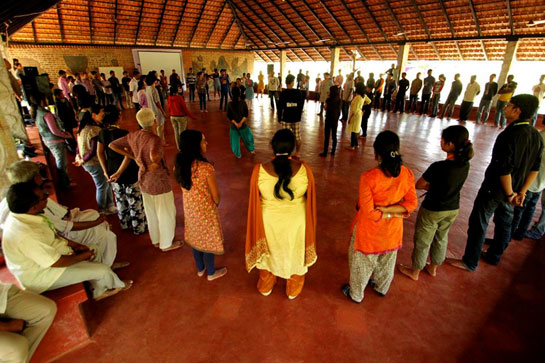
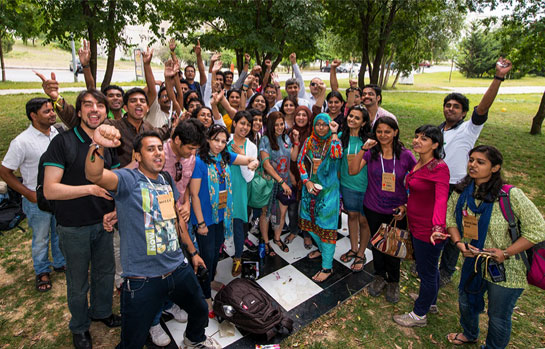
Udaan 2013 (Power Shift India) was part of a larger, international project called Global Power Shift, initiated by 350.org, which had its inaugural international kick-off in Turkey in June 2013. Global Power Shift, and Power Shift conferences in countries around the world such as Udaan 2013 in India, are seeking to empower youth to communicate the issue of climate change, to lead national, regional, and local campaigns aimed at mobilizing increasing numbers of youth, and to join hands with communities on the ground whose lives are being disrupted by coal mining, extreme weather events, deforestation, and other climate-related phenomena.
350 India will use the momentum created by Global Power Shift's Turkey meeting and the Udaan meeting in Bangalore in December, to launch a nationwide climate campaign powered by leaders skilled at leading local action groups. 350 India's leaders hope to create a groundswell of support in India for national and global mass action on climate and for a clean energy future in India, in 2014 and 2015.
In the past month, 350 India has launched a campaign calling for Prime Minister Singh to remove Mr. Veerapa Moily from his position as Environment and Forest Minister, on the grounds that Mr. Moily apparently views his Ministry as an obstacle to the industrial development of India. 350 India is also calling on World Bank President Jim Kim to revoke the Bank's funding to the Tata Mundra coal-fired power plant.
350 India can be contacted at: southasia@350.org
For information about 350 India's campaign to remove MOEF:
MoEF: Ministry of Environment & Forest or Moily's Office of Environmental Failure.
For information about the campaign against the World Bank-funded Tata Mundra coal plant:
Ask Jim Kim.
Click here for a video from Udaan 2013:
https://www.youtube.com/watch?v=a7Tycj5hJt4
Click here for the Udaan 2013 website:
Why Udaan.
Click here to support 350 India:
https://www.facebook.com/350India
Author: Jennifer Scarlott, Source: 350 India.
Link to the published article:
Udaan 2013 Leaping Into 2014.

