China Continues As Nexus Of Wildlife Crime
Author:
First published in Sanctuary Asia,
Vol. 34
No. 1,
January 2014
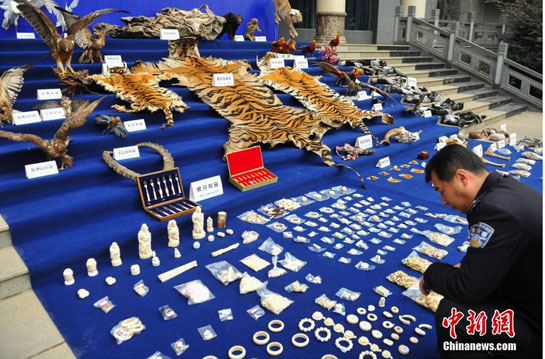
On January 22, 2014, Debbie Banks of the Environmental Investigation Agency (EIA) alerted Sanctuary to seizures of wildlife products by the Forest Police of Yunnan province, China. The display photographed above contains products confiscated between 2013 and early 2014.
In this time period, the Yunnan Forest Police investigated 23,305 cases of wildlife and forest crimes and confiscated 6,619 wildlife products. A total of 126,678 wildlife products were confiscated nationally in 2013 and the first weeks of 2014. The province of Yunnan in the People's Republic of China is located in the far southwest of the country, bordering Myanmar, Laos, and Vietnam. It spans approximately 394,000 square kilometers, and has a population of 45.7 million.
In his article for Sanctuary titled “The Wildlife Crime Nexus," (see link below), Samir Sinha, former head of WWF-India's Traffic cell, said, “The illegal wildlife trade is no longer small, sporadic and inconsequential. In its new avatar, it's like any other mainstream criminal activity - well-organized, well-funded, ruthless and transnational."
Because the wildlife trade has become international in scope, it has finally gained the attention of global bodies like the U.N. In September 2013, Yury Fedotov, Executive Director of the UN Office on Drugs and Crime (UNODC) called on states to strengthen global efforts to combat poaching and illicit wildlife trafficking, warning that these activities are now “transnational organized crime being carried out on a massive scale."
Mr. Fedotov said, “Poachers and other criminals are driving elephants, rhinos, tigers, and many other species to the verge of extinction, around the globe. These criminals are destroying local livelihoods, upsetting fragile ecosystems, and hindering social and economic development. They are fuelling violence and corruption, and undermining the rule of law." Fedotov called on states to treat poaching and the trade in illegal wildlife products as serious criminal offences, to strengthen legislation and criminal justice systems addressing the problem, and to reduce demand driving the trade. “We need to raise awareness of the devastation caused by the markets for ivory, rhino horn, bushmeat, exotic parrots and shark fins. We must make consumers aware that this crime is far from victimless," said Mr. Fedotov.
In a joint article for The Guardian dated September 26, 2013 and timed to appear as the General Assembly began a new session in New York, Mr. Fedotov and John E. Scanlon, Secretary-General of the Convention on International Trade in Endangered Species of Wild Fauna and Flora (CITES), declared their determination that the world pay attention to wildlife crime: “We intend to deliver a single key message - Let's make wildlife crime a serious crime in national legislation, apply enforcement measures throughout the entire enforcement chain, build a rapid response, share intelligence and break the power of the criminal networks while halting their profit flow."
The CITES Secretariat and UNODC are partners in the International Consortium on Combatting Wildlife Crirme.
Author: Jennifer Scarlott, Sources: Environmental Investigation Agency, The Guardian, UNODC
For more information click here:
Poachers Active, Government Asleep.
The Wildlife Crime Nexus.
Widespread Tiger Poaching In M.P. And Maharashtra.

