Conservation Opportunities Through Agroforestry
Author:
First published in Sanctuary Asia,
Vol. 35
No. 4,
April 2015
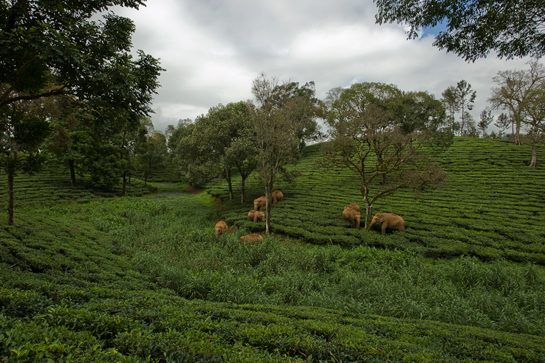 Photo: Kalyan Varma.
A new interdisciplinary research paper titled ‘Political ecology of commodity agroforests and tropical biodiversity' has provided the framework for further research on this complex yet crucial model for conservation. The authors of the paper include political scientist Dr. Paul Robbins of University of Wisconsin, economist Dr. Ashwini Chhatre of Indian School of Business and conservation biologist Dr. Krithi K. Karanth of the Wildlife Conservation Society.
Commodity agroforests like coffee, rubber, or areca nut plantations are increasingly being adopted as new opportunities to increase habitat for wildlife. These are in addition to ongoing efforts to preserve and increase natural forest cover and manage protected areas.
‘Reconciliation ecology' argues that human-modified landscapes such as these agroforests can and need to be explored and valued as potential wildlife habitats. This is critical considering agroforests cover far larger areas in many tropical countries than protected areas. According to some estimates, over 25 million hectares are under agroforestry in India - a significant amount considering national forest cover is less than 70 million hectares as per the ‘India State of Forest Report 2013'.
Large-scale agroforests are known to provide refuge and dispersal routes to wildlife species from adjoining natural forests. However, planning biodiversity conservation in these landscapes is more complex than their natural counterparts. The difficulty lies in understanding the processes that influence habitat for biodiversity in plantation agroforests. Unlike natural forests influenced primarily by local parameters, biodiversity in agroforests are impacted by a wider range of components.
Habitats in agroforest plantations are directly affected by human-decision making, which in turn are influenced by economic incentives, government policies, and other political and economic factors. “Biodiversity in these plantations are influenced by cumulative impacts of these diverse factors and highly-complex processes that remain poorly-studied," says Dr. Krithi K. Karanth, a co-author of the paper.
The paper reviewed available knowledge on the subject, explored gaps and laid out methodological recommendations to advance existing knowledge on the role of commodity agroforests in biodiversity preservation.
The authors contend that a ‘chain of influences' contributes to explaining presence or absence in commodity agroforests. Explaining the chain, Dr. Karanth says “Species populations in plantations are influenced by agro-ecological conditions such as canopy density, greater herbaceous ground cover etc. The latter in turn are influenced by producer's choices and strategies such as availability of labor, scale of operation, etc. These choices and strategies will be influenced by regional or global politico-economic forces including market prices, transportation, subsidies, etc."
“If we are able to understand these processes clearly, we will be able to define policies, which are mutually beneficial to agro-forest plantations as well as biodiversity," she adds, cautioning that these can only provide additional habitats, and can never fully replace natural habitats for wildlife.
Source: Wildlife Conservation Society India.

