Defending Paradise
Author:
First published in Sanctuary Asia,
Vol. 39
No. 11,
November 2019
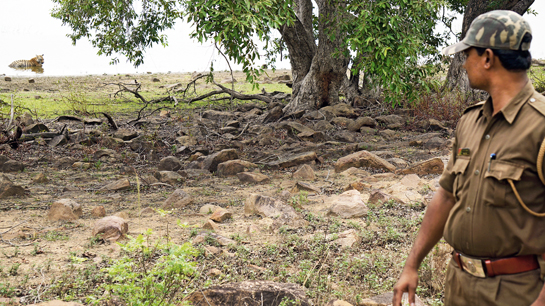 Photo:Kalli Fullerton Doubleday
Praveen Pardeshi, Principal Secretary, Chief Minister's Office, Government of Maharashtra, has played a key role in securing Maharashtra's forests, whose tigers have responded by expanding into newly-rejuvenated areas. The greater Tadoba landscape has been transformed into a world-class nature reserve, through the simple expedient of protecting its connecting corridors, empowering communities to earn tourism revenues, and winning the support of young people living around this miraculous tiger forest. What follows is an insight into the complex factors that go into protecting tigers, and the fragility of our efforts to save the species from oblivion. Primary among these was the crystal objective of ensuring that living tigers added more to the village economy than dead tigers.
In 1983, the mass flowering of bamboo transformed Tadoba's landscape into a bamboo savanna. A billion seeds across the forest floor created a carpet of shoots, allowing sambar, chital and gaur to thrive. The unique ecotone offered them greater opportunities than most dry deciduous forests where unlimited fodder is confined to the post-monsoon months. Palatable plants such as bamboo shoots and leaves offered sustenance for herbivores in high summer, enabling them to successfully raise families, often bringing two fawns to maturity each year. Thus began the era of fecundity in the greater Tadoba landscape.
FLASH FORWARD TO A LAND OF TIGRESSES
The dramatic improvement in herbivore population in the landscape naturally allowed Tadoba's apex predators to thrive. By 2000, tiger numbers were rising steadily. A series of conservation initiatives and a decade of enhanced protection helped seal this positive trend. The rehabilitation of the Pandharpauni village, for example, ushered in remarkable regeneration and the resulting meadow, centred around the old village, became a favoured watering hole and breeding ground.
In 2011, the Pandharpauni meadow and its lakes became the domain of Bhala, the tigress, who has so far already raised three litters. Her third, three female cubs and a male, came into their own around the same time as that of Madhuri's, another Tadoba tigress, who too raised an all-female litter of four near the Telia lake. Officials were delighted when they learned that the Katejhari female too was bringing up three female cubs. Tadoba was being transformed into a land of breeding tigresses, defying the notorious Indian-male bias!
Understandably, Bhala, Madhuri and their cubs were the show stoppers during the 2011-2012 ‘season'. Visitors were enthralled and the stories they told attracted more and more people to Tadoba. Nearly everyone was assured of the sight of tiger after tiger throwing them nonchalant stares, while sauntering casually along the dusty roads of Pandharpauni and Telia.
I encountered Bhala and her six-month-old cubs when I first visited Tadoba in the winter of 2011. I had been appointed Principal Secretary, Forests, for Maharashtra and I fell instantly in love, not just with Tadoba, but all the wildernesses of Vidarbha.
But all was not well in this paradise.
In 2013, we found Bhala lying dead in a pool of water near Pandharpauni. Many assessments were made, and a veterinary opinion suggested that she had been bitten by a viper. However, persistent under-currents attributed the death to poisoning by villagers. Tadoba's Critical Tiger Habitat housed as many as five villages in 2011, Jamni and Navegaon-Ramdegi in Tadoba range and Palasgaon, Ran Talodi and part of the Kolsa village in the Kolsa range.
MAKING SPACE FOR TIGERS
Efforts had been made to rehabilitate villages as far back as the year 2000, but the rehabilitation of Kolsa had run into problems: the land offered to those who agreed to shift was not irrigated, the houses were built by government-appointed contractors and did not match up to the expectations of the people. A human rights group ran a vociferous campaign against the rehabilitation process. One way or the other, the Kolsa rehabilitation was stalled and remained so until 2004-2005. This set a bad precedent, reinforcing the long-held belief that rehabilitation does not work.
I consulted with scores of groups to understand the issue and whether there might actually be an alternative to rehabilitating people from the inside to the outside of tiger forests. Social activists insisted that co-existence between people and tigers and other wildlife was possible. After all, they pointed out, for the last millennia, humans and wildlife did manage to coexist, and indigenous people and forest dwellers are recognised the world over as worshippers and protectors of nature.
I really took no position at the start of my enquiries. As one interested in the history of humans, I looked back at the advance of man into the Indian subcontinent from around 1500 B.C. Settlements followed the course of the Gangetic plains, 100 per cent of which was occupied by tigers and other mega predators. Today, barely 2.46 per cent of our geographical expanse is tiger-occupied. Clearly the retreat of tigers was total. Had we not set aside inviolate areas for tigers, they would almost certainly have been extinct by now. But, one could well argue that the decline was a result of modern, industrial, urbanised humanity, and not pastoralists and forest dwellers, who actually do live in closer harmony with nature than their counterparts in large cities.
The reality is different and counter-intuitive. A plain examination of the current distribution of tigers in India reveals interesting truths. Tigers and other megafauna have practically been extirpated across vast stretches of Chhattisgarh, Orissa, the Eastern Ghats in Andhra Pradesh, Jharkhand, Tripura, Mizoram, Nagaland, Manipur and Arunachal Pradesh. Even camera traps reveal swatches of forest, virtually devoid of tigers and other large mammals. Switch to Chandrapur, and bang next to coal mines and cement factories, you will find some of the densest tiger forests. Travel but a few kilometres away to the vast forests of Gadchiroli where there is no industry to speak of, and tigers and megafauna vanish again. Could this be an aberration? Let's look at Madhya Pradesh. Here, around Kanha, tiger densities rise dramatically, despite its proximity to Jabalpur and its sprawling urban-industrial satellites. But when you look at Achanakmar and its adjoining sanctuaries in Chattisgarh, with almost no large urban-industrial complexes, again, tigers and other megafauna go missing.
Let's move to south India. Here too, wildlife survives in relative proximity to the Bangalore-Mysore urban industrial sprawl. It really is counter-intuitive. And it merits study, whether the relationship between urban-industrialised Indian society and tigers, is less inimical to tigers than large numbers of people practising agriculture on the basis of forests being converted to marginal, often failed farms.
I hasten to add, that I am not making a case here for creeping industrialisation into forest India. Far from it. What I am flagging and questioning is the hitherto strongly-held belief that small farm holdings are sustainable insofar as large megafauna such as elephants, tigers and rhinos are concerned. The question that arises is whether stricter protection is more feasible closer to urban sprawl, than vast rural landscapes that seem to end up in ‘empty' (of megafauna) forests.
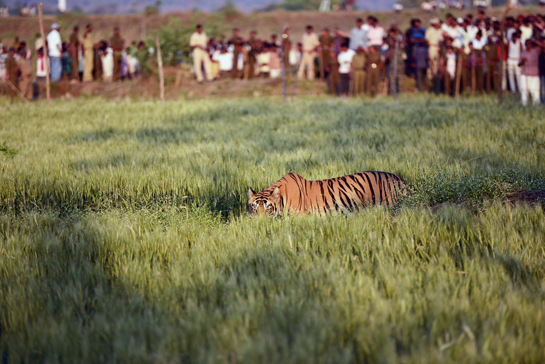 Photo:Nikhil Tambekar
DOES REHABILITATION WORK?
When I first visited Jamni village, the villagers gave me an ultimatum. “Either make it possible for us to be fully and satisfactorily rehabilitated, or provide us with black top roads, 24x7 electricity and better education for our children." They also demanded that the entire village precincts including homes and farms be protected by way of electrified fencing. Seen from their perspective, the demand was justified. Where wildlife is effectively protected under the Wildlife (Protection) Act, 1972, something between 40 and 60 per cent of crops such as paddy and cereals are consumed by wild pigs, deer and gaur. And when you add the impact of grasshoppers and beetles, the damage takes on even graver dimensions.
There is more. In 2011-2012 alone, over 47,000 incidents of human-wildlife conflict were recorded and a compensation amount of over Rs. 9.77 crores was paid by the Maharashtra government. When you consider that most such incidents actually go unreported, the scale of the problem can be imagined. Put simply, forest dwellers who live in close proximity to dense wildlife areas are condemned to having an adversarial relationship with megafauna, particularly when you consider that most areas, in Vidarbha particularly, can offer only poor-yielding, rain-fed crops.
One very angry man I met in the Jamni village asked me again and again: “Why does your tiger come into the village every day and walk down our street?" The fear and loathing is understandable. Every year in the greater Tadoba landscape, about eight to 10 women die on account of tiger or leopard attacks when they step into deep forest to collect fuelwood, fodder, tendu or mahua flowers (and probably most often when they crouch to answer nature's call).
I can even understand the motivation of some civil society groups that have historically opposed the rehabilitation of villages because in the past such shifts may have been coercive and unjust. But times have changed. Today, dramatically better terms are offered to village communities that wish to move closer to markets, jobs, highways, roads, hospitals and schools. Given this reality, villagers themselves are demanding relocation and petitioning the government to offer them the same, strong, policy packages that their counterparts in other villages receive.
After multiple meetings with villages in Tadoba, (and Melghat, Navegaon and Koyna), we arrived at a policy-matrix and process that could be considered beneficial to both people and wildlife. We expanded the National Tiger Conservation Authority guidelines (Rs. 10 lakhs per family, or their choice of land and civic amenities). Not only did the Government of Maharashtra approve the sum of Rs.10 lakhs per family (counting all 18-year-olds, boys and girls, as separate families), but also made it possible for families to combine the cash package with a choice of alternative village sites, homestead plots and basic civic amenities such as drinking water, electricity and school buildings.
And how did we do this? Well, the people of Tadoba's Navegaon village themselves came up with an innovative solution. In every family, the father chose land-for-land as his option, while one of his eligible sons chose the Rs. 10 lakhs package. That way the government was able to provide homestead plots for every nuclear family, together with farmland, irrigation tanks and canals, and schools. Simultaneously, adult children got the Rs. 10 lakhs package. In villages that chose just the Rs. 10 lakhs package, we nevertheless also provided gaothan (homestead) sites with every amenity we could including water, schools and electricity, all obtained through other existing schemes including rehabilitation, the Tribal sub-Plan and funds from the Tiger Foundations especially set up to better manage the larger landscape.
To ensure fairness and transparency, a committee of officials and village representatives was established to monitor and resolve issues, including grievances of families left out of the ‘eligibility list'. It was by any account a meticulous planning process involving the Field Director of Tadoba, Dr. Vinay Sinha, Kalyan Kumar, the Deputy Conservator, who were both helped by the dedicated detailing provided by the sarpanch (village head) of Navegaon, Azhar Sheikh, and Nanaji Uike of Jamni village. The result of cooperation from all sides, instead of confrontation was that Navegaon and Jamni smoothly relocated to sites that they had themselves chosen, which were connected to state highways, with the blacktop roads they always demanded. Of course there was much more - computer-aided teaching, 24x7 electricity and water supply were all on tap. Many families placed their children in private schools in Khadsangi and Chimur. There were attempts to discredit the very concept of rehabilitation, based on preconceived notions, but the villagers were genuinely happy. And they spoke to other villagers. That is why, today, over 60 villages living in close proximity to tiger habitats across Maharashtra are asking to be rehabilitated.
But what of Bhala's four orphaned cubs? With people moving out of Jamni, one of Bhala's daughters, referred to as Maya, occupied her mother's range in Pandharpauni and further into the Jamni village, pushing her two sisters to the outlying buffer areas. Maya has now mated with two of the dominant males of Tadoba and produced a litter just near the lake guest house. The vacated Jamni fields and the lake served to expand the available space for tigers and are occupied by a female bringing up a new family.
THE GIRL GANG OF TELIA
While Bhala was raising her young ones in Pandharpauni across the park, the Telia lake in Moharli range was home to a female called Madhuri and her four girls. They led an idyllic life, resting in the moist swamps below the Telia dam, learning to hunt from their mother. For two full years in the open woodlands on the shores of the Telia lake, these five tigers regaled thousands of visitors with heart-warming sights. Then, following the diktats of nature, the huge Waghdoh male, also called Scarface, returned to mate with Madhuri. It was time for the Telia girls to move out and since Telia lay at the very edge of the core area, the girls were forced to occupy human-dominated forests in the buffer.
The return of males to mate with prized females is central to tigers' existence. But equally, it is central to their existence that the female pushes her cubs out as the dominant male could well kill one or more of them, particularly if they are males. Apart from distributing predation pressure evenly across the forest, the outward movement of the cubs from the mother's range boosts genetic diversity, by keeping the gene pool healthy.
But this outward shift from the protected core to the buffer and other forests is fraught with danger. Humans, with their version of co-existence, have stamped the entire landscape with agriculture and settlements. Modern infrastructure of roads, railways and canals has further fragmented the contiguity of central Indian forests. What makes it riskier for young tigers like the Telia cubs is their change of diet from natural forest prey to the freely available domestic livestock that have virtually stripped the forest floor of the palatable plants essential to the survival of wild herbivores.
The Tadoba landscape has viable forests surrounding the core. But here the population of wild pig, chital and sambar is scarce. Despite Madhuri having taught her cubs to avoid human beings and avoid cattle kills in the normal course, the young dispersing cubs in human dominated forests are forced to do so. This results in angry villagers who drive away the cubs. Crazed with hunger, they may take extraordinary risks, and this may result in human deaths too. One dispersing tigress tragically killed five women north of Tadoba and had to be shot dead.
However, often, simple solutions to apparently intractable problems do exist. The challenges of human-wildlife conflict need new paradigms that address them quickly and effectively. The spate of human kills by the tigress of Gondia needed quick action. Almost all the tiger and leopard kills were of women who had entered the forest for fuelwood or fodder. We launched a massive programme to provide bio-gas or LP Gas. Using funds from our specially set up Tiger Foundation (financed primarily from tourist entry fees), as many as 4,500 women received LP gas connections at a 75 per cent subsidy, with a promise of subsidised refill cylinders for five full years. This has dramatically reduced the frequency of human entry into the forest.
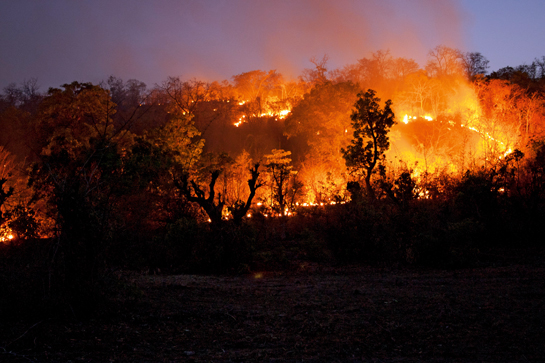 Photo:Amol Khedgikar
THE POACHING THREAT
Just outside protected cores, tigers face what is possibly their gravest threat - poaching. Poaching syndicates are market savvy and operate professionally through a system of advance payments for ‘orders' placed by traders from as far away as Tibet and Nepal. The traders channel tiger bones, skins and parts to what is called the Traditional Chinese Medicine (TCM) market. The key operatives on the ground are the Bahelias of Katni who understand tiger ecology as well as any wildlife biologist and whose motivation levels are matched by their skills the moment they have the tainted cash in hand. Renowned for delivering tiger body parts, these experts can easily identify individual male tigers that have dispersed from core areas, because they monitor their progress as they are growing. Their preferred time to kill tigers is summer when the cats follow fixed routes to favoured waterholes which are targeted by laying steel leg traps. Tadoba has been repeatedly struck by these poachers with the Pandharpauni male cub and several other far-ranging males falling victim in the Gond-Moharli buffer zone.
Though the rehabilitation of villages has been central to the success of Tadoba, we had to consolidate it by strengthening our anti-poaching measures. This would involve innovative out-of-the-box policies and practices, so that a trade accustomed to routine protection is thrown off balance. It goes without saying that this will only be possible if the protection teams are well equipped, trained and motivated. One way we are attempting to do this is by ensuring that the community living around the greater Tadoba landscape area becomes the primary beneficiary of biodiversity conservation. Essentially, we are working to turn the buffer area back into the thick forest it was and making local communities the primary beneficiaries of conservation by winning their participation in human-dominated forests capable of guaranteeing them dignified, even lucrative, livelihoods.
We knew that everything is secondary to physically protecting the forest by ringing its periphery with eyes on the alert and boots on the ground. In the summer of 2011, we had only 38 guards to protect 693.33 sq. km. of Tadoba. The 1127.17 sq. km. buffer was under the management of the Territorial (revenue generating) Wing and Forest Development Corporation of Maharashtra management, neither of which saw wildlife protection as their primary responsibility.
Fortunately things have changed. Over months, several decision makers were taken to Tadoba to see first-hand how tigers had responded to the new initiatives to safeguard them. As though on cue, all too often, the entire Telia family would turn up to welcome one key decision maker after the other. In due course, we won approval for our long-pending demand to beef up protection by sanctioning a Special Tiger Protection Force (STPF) to be put in place. This enabled a battalion of specially-recruited guards who were systematically trained to patrol difficult jungle terrain and track poachers. Almost instantly we found our protection staff strength enhanced to 138 individuals.
It takes 3600 vision to effectively protect large landscapes, with porous boundaries. At the heart of Tadoba's turnaround was law enforcement. The reason tiger poachers are rarely convicted is lack of evidence, tardy investigations and non-pursuit of the trials in court. The spate of tiger poaching cases demonstrated just how easy it was for poachers to target the dispersing tigers in the buffer areas and other unprotected forests. A series of joint judicial-forest police workshops to understand the nuances of the Wildlife (Protection) Act, 1972 were initiated with the support of the Chief Justice of the Mumbai High Court, Justice Mohit Shah and Justice Gavai. Forest and court officials learned how common mistakes could queer a legal pitch. Aiding and assisting this process was an extremely pro-active police officer - Inspector General of Police with the Central Bureau of Investigation, Keshav Kumar, who skillfully demonstrated the value of forensics and how matching DNA from seized tiger flesh with samples from under the nails of the accused by the Central Molecular Biology Laboratory helped present clinching evidence leading to convictions. The workshops also revealed the immense concern that judicial officials have for India's wildlife and their frustration at being presented with faulty evidence that often resulted in delays and acquittals.
A cyber cell to detect and collect wildlife crime data and evidence was set up. Call data records of the accused were analysed and tracked by the Honorary Wildlife Warden of Amravati, Vishal Bansod. Apart from the accused, the traders purchasing and transporting the wildlife contraband were tracked by a team led by investigating forester Ramgaonkar, assisted by a volunteer, Vishal Mali. The trail led to Delhi, Vishakapatnam and Madhya Pradesh where undercover raids were conducted.
These kinds of actions seldom need reporting. But those who care for wildlife should know that such actions resulted in the fastest tiger poaching trial imaginable. The lessons learned at the workshops enabled the team to successfully investigate the case and collect forensic evidence that turned out to be legally rigorous. In the event, all the accused were denied bail, despite their appealing all the way to the High Court and engaging highly-paid lawyers they were probably able to afford because of the huge sums made available by the poaching syndicates. Another by-product of the judicial workshops was a flood of excellent lawyers willing to work pro bono for the Forest Department on wildlife cases. Thirty people accused of tiger-poaching, abetting and trading were remanded to custody for six months and three tiger poachers were handed terms of five years rigorous imprisonment.
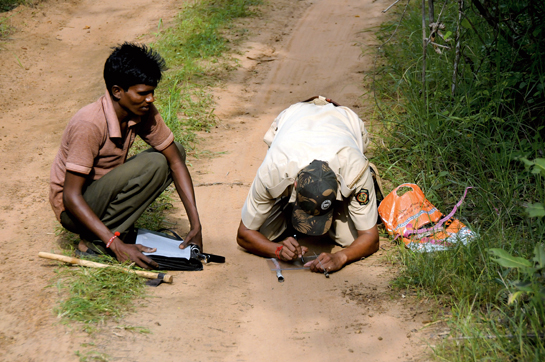 bästa internet casino som finns på den smarta sajten Videospelautomater. Fed by the Irai dam and privy to superior protection from both local communities and officials in recent times, the buffer of the reserve is gradually becoming flush with wildlife." title="A forest guard and his assistant carefully trace the pugmark of a tiger after they noticed its exceptionally long stride. While camera traps have replaced the controversial ‘pugmark' method for counting tigers, forest guards still carefully monitor wildlife spoor to evaluate the presence-absence and overnight movement of big cats. Fed by the Irai dam and privy to superior protection from both local communities and officials in recent times, the buffer of the reserve is gradually becoming flush with wildlife." width="545" height="362" /> Photo:Vedwati Padwal
CAN SUSTAINABLE TOURISM COME TO THE TIGERS' AID?
As one who is engaged with matters involving both administration and wildlife protection, I know that increased tiger numbers must end up providing additional incomes and sustainable livelihoods to fringe villages. If we fail to ensure this, we will not win their support for wildlife conservation. Toward this end we arrived at two interventions: we documented high wildlife density spots in buffer areas and then opened safari routes, which would be managed by local villagers. In Devada, Agarzari and Navargaon, the village Ecological Development Committee was authorised to man an entry gate. The entry fee of Rs. 500 per vehicle went directly to them. What is more, local youth were first trained and then employed as wildlife guides. Today, these villages are earning a significant Rs. 10 lakhs per season from tourist safaris. Devada ended up earning one lakh rupees each summer month and as many as 118 young men found gainful employment as guides and drivers. How was all this possible? Well, the buffer route of Agarzari became hugely popular thanks to regular sightings of a tigress with her cubs.
Living tigers had actually become more valuable to the village economy than dead ones.
Inherent justifications aside, today's economic reality is that ecosystem services must be tabulated and shared if the true value of wild nature is to be accepted by society.
In 2010, Tadoba earned Rs. 30 lakhs in tourism revenue. By 2014, this figure reached Rs. three crores. A system of online booking of safaris was made mandatory and the fees were raised to reflect the true cost to society for protecting and setting aside vast areas of land. The Tadoba Tiger Foundation collects the entry fees and passes on 50 per cent as a development grant to each buffer village, retaining 50 per cent for its own conservation and management costs, including patrolling, fire-fighting and the construction of waterholes. Villagers now know the funds are put to beneficial uses such as LPG connections, their village tanks and the check dams that help provide life-giving water in high summer.
We also chose to hand over the catering and hospitality services of the forest rest houses to Womens' Self-help Groups, for instance the Moharli Mahila Mandal. However, all this is still a drop in the ocean. There are 79 villages with a population of 75,000 in the buffer zone. To meet their livelihood needs, a Forest Department official by the name of Gajendra Narawane has been working with communities over the past year to hammer out ways to turn enhanced biodiversity into better living standards. For instance the timber extraction earthen roads that had earlier been cut, have been designated as wildlife safari routes. Local villages are being trained in the art of natural history story telling by Honorary Wildlife Wardens and NGOs. Tourist activities that are not permissible inside the core area are encouraged in the buffer and this includes adventure activities such as hiking, cycling, kayaking in the adjoining Irai dam reservoirs, and most importantly, helping village homes to double up as homestays for low-budget adventure tourists. All this takes time, but the green shoots of success are self-evident and the best sign that things are working is the steady improvement of the relationship between people and the park.
BACK TO THE TIGERS
As mentioned above, Tadoba had experienced a veritable female tiger cub boom in 2011. These new tigresses began to seek territories in the connecting forests around Tadoba's buffer and beyond. Meanwhile, in the Nagzira Wildlife Sanctuary, nearly 150 km. from Tadoba's core, another tiger story was unfolding. Dendu, the dominant male had mated with the resident female and produced two male cubs, named Jai and Viru after two iconic characters from the Bollywood film Sholay! Both were Nagzira show-stoppers. Jai grew fast and by the second year he was already so huge and strong that he displaced his father Dendu, and began to dominate the rich forests around the Nagzira lake. But then in the winter of 2013, he vanished completely. Weeks passed and wildlifers feared the worst - that poachers had taken him. Forest officials, tourists, even the citizens of Nagpur, Gondia, Chandrapur and Umred were aghast and in mourning.
And then, just as suddenly, Roheet Karoo, Honorary Wildlife Warden, Nagpur, who lives in Umred contacted forest officials with startling news. Jai, he claimed, had been seen in the Umred-Karhandla forest, some 150 km. away from Nagzira and just 40 km. from the boundary of Tadoba. Doubts were expressed, but when camera trap images were compared, the identification was confirmed. This massive tiger had travelled at night, used shallow stream beds around the Ghosikhurd reservoir to reach a forest that was still off the world's radar. Why? The herbivore population of Nagzira was high and the obstacles in his path, rail lines, highways, canals and semi-urban dwellings, were anything but conducive to tigers. Yet Jai had walked a dangerous path to arrive at a thinly tiger-populated forest.
The reason became apparent when it was discovered that Tadoba's young, fertile females had dispersed to Umred. Tiger biology was at work and all we needed to do was pay attention and remove obstacles in their path.
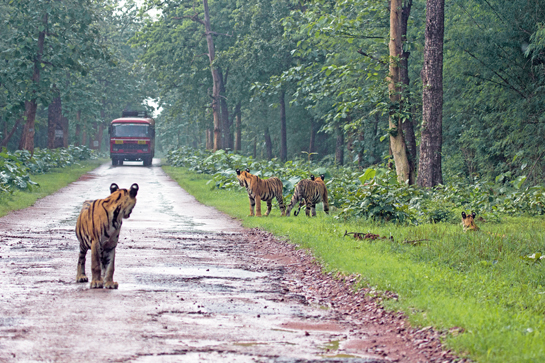 Photo:Indranil Paul
THE IMPORTANCE OF CONNECTIONS
Jai was lucky. But many other major carnivores meet their end while traversing linear forest intrusions such as canals, highways and railway tracks. The tiger landscape that connects Jai's Nagzira family to the Pandharpauni females suffers multiple fragmentations. We actually consulted with local MLAs from Gondia and Nagpur and opened up a dialogue with our Honorary Wildlife Wardens and Park Directors on how to better link Nagzira with Tadoba for the benefit of tigers. We took advantage of scientific inputs from the Wildlife Institute of India and expanded the area of the Nagzira Wildlife Sanctuary from 150 to 400 sq. km. The Navegaon National Park area doubled from 130 to 260 sq. km. But the distance between the girls from Tadoba and the boys of Nagzira was still a bridge too far. We, therefore, identified a 180 sq. km. parcel of forest land midway between Nagzira and Tadoba, around Umred-Karhandla, and notified this as an additional sanctuary, using the drive and on-ground work of Roheet Karoo who in turn worked very closely with Rajendra Mulak, MLA.
The tiger Jai has become the dominant male in the forests of Umred-Karhandla and has been observed mating with several females here, including the members of Tadoba's young girl gang! Clearly something has worked. Without the need of scientific appraisals, or committees, the tigers of the larger Tadoba landscape have given a huge thumbs up to the people-centered conservation efforts put in place over the past three years. Nothing exemplifies this better than the fact that on a full moon night in May 2014, wildlife volunteers that had been roped in to conduct a department-led waterhole count, recorded as many as 35 separate tigers in the core and 27 tigers in the buffer area of the Tadoba-Andhari Tiger Reserve. Camera trap images confirm the veracity of such counts as they reveal the positive presence of about 40 adult tigers in the Tadoba core and up to 20 adults in the buffer.
We know without doubt that tigers can be saved. We know without doubt that Vidarbha has the potential to be a virtual junction for tigers in India, with connections to Nagarjunasagar-Srisailam to the south and Kanha and Achanakmar to the north and east. What remains to be done is to bring all players, governments, NGOs, local communities and scientists together in joint purpose.
The battle cry of the children of India, “We can and will save the tiger" must be made to come true.

