Diclofenac In Diminutive Doses Only
Author:
First published in Sanctuary Asia,
Vol. 35
No. 8,
August 2015
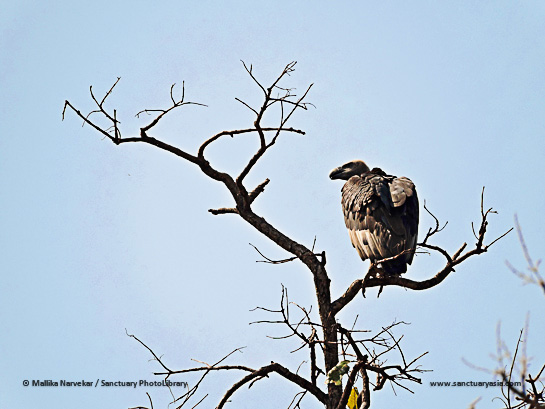 Photo: Mallika Narvekar.
By 2007, the population of vultures in India had dwindled from four crore to one lakh. Studies showed that multi-dose diclofenac, an anti-inflammatory drug was the culprit. The ingestion of the drug, consumed when scavenging on the carcasses of cattle that had been treated with it, had caused vulture populations to crash. Though veterinary use was banned in 2006, cattle owners continued procuring up to ten times the prescribed limit to treat their cattle.
Now, as per a gazette notification issued by the Union Ministry of Health and Family Welfare on July 15, 2015, the drug will be available in vials of 3ml only. The bulletin reads, “Diclofenac injection for human use shall be available in single unit dose pack." The order virtually puts an end to illegal procurement of human diclofenac by cattle owners. This inexpensive, non-steroidal anti-inflammatory drug is used by cattle owners to treat limps and related ailments in animals.
The Oriental White-backed, the Indian Long-billed, the Red-headed and the Egyptian vulture species are those commonly found in the country. According to the Bombay Natural History Society (BNHS), their population in the wild has declined by nearly 99% in the last two decades. “The recent notification by the ministry is a big relief to these critically endangered vulture species," the BNHS said. Out of the 70 firms manufacturing the drug across the country, only three firms have voluntarily ceased production, the BNHS said.
S. Bharathidasan of Arulagam, a Coimbatore-based vulture conservation organization, said drug controllers in Tamil Nadu have been very proactive in curbing the menace of diclofenac. “They have raided medical shops that sold the analgesic. The forest department too should co-ordinate with drug controllers and regularly monitor shops located close to sanctuaries to stop illegal sale," he said.
By controlling the dosage available for consumption, population figures of the winged scavengers may have a chance of steadily increasing in the future.
Source: The Times of India

