E-Base - Creating Environment Leaders Of Tomorrow
Author:
First published in Sanctuary Asia,
Vol. 34
No. 6,
June 2014
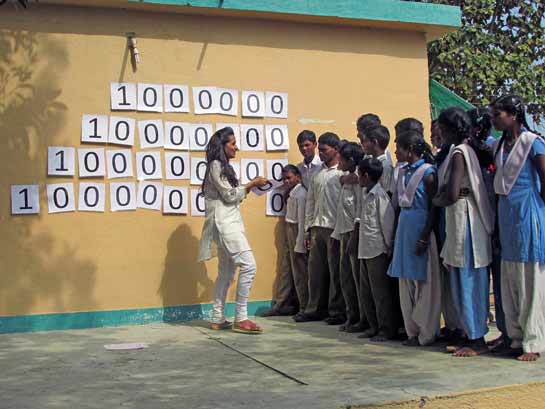 Photo: Subhash Bhawre.
At the Turia Gate of the Pench Tiger Reserve, Madhya Pradesh, there is a space reserved specially for students that serves as both classroom and training centre. Here ideas on the environment, science and conservation are exchanged, learning is imparted, curiosity is aroused and environmental sensitivity is encouraged. This is the Conservation Wildlands Trust's Education Base, or CWT E-Base.
Virtually everyone now agrees that India's food and water security is linked to the survival of the tiger and its forest home. This is the central rationale that prompted CWT to establish its E-Base at the Pench Tiger Reserve, Madhya Pradesh, in 2011. Located in the Interpretation Centre at the Turia Gate, the facility helps to connect the Forest Department, the local community and tourists with a common objective - conservation and sustainability. Run on solar energy the E-Base was inaugurated in 2011 by polar explorer and environmental leader Robert Swan, who set up his ‘2041 E-Base' at Bellingshausen Island, Antarctica, in 2007.
The E-Base serves as a classroom for local community children to learn and implement content related to conservation and sustainability in their schools and homes. It provides an environmental curriculum that enhances children's awareness about their environment, while instilling a passion for the natural world. The curriculum is customised to environmental issues that have a direct impact on local communities. Additionally, documentary films on wildlife conservation and sustainability are screened for the benefit of all those living in the area and for those who visit.
Relying on innovation, practical hands-on experiences the initiative promises to inject a new impetus into nature conservation, designed for local children who will tomorrow determine whether the tiger lives or dies. At the time of writing as many as 1,200 students from schools in Turia, Teliya and Kohka (on the Turia side) and Sarrahi, Paraspani and Tikadi (on the Karmajhari side) of the reserve have been reached.
Over the past two years, CWT has seen small but significant changes in the students who are not only taking charge of waste management, but also in the protection of the park itself.
One thing that Sanctuary readers could do for the initiative is to donate books or money to buy books for the very vital E-Base library, which is in need of material on biodiversity, science, environmental conservation, Gondi folktales and encyclopedias, in both, Hindi and English. These will go a long way in dealing with language and environmental literacy, particularly since local teachers have begun to rely considerably on the library.
CWT has launched a crowd-funding campaign for its library. More information is available here: http://bit.ly/1qXVCBG. Sanctuary readers may also directly write to: Pooja Choksi (pooja@conservationwildlands.org), who heads the E-Base initiative at the Pench Tiger Reserve. |
First appeared in: Sanctuary Asia, Vol. XXXIV No. 3, June 2014.

