Facebook Called Out For Aiding Wildlife Trade In Thailand
Author:
First published in Sanctuary Asia,
Vol. 38
No. 9,
September 2018
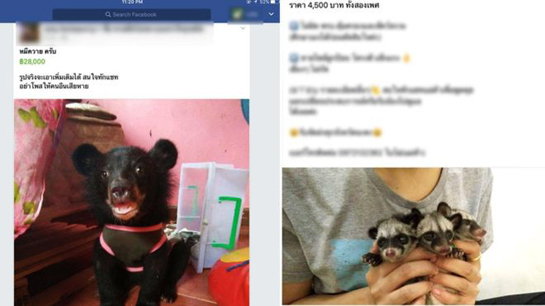
A disturbing trend was recently brought to light in a study by TRAFFIC, a wildlife trade monitoring network, has recorded illicit wildlife trade through online groups via Facebook in Thailand.
Researchers from the international wildlife trafficking monitor have discovered yet another medium of wildlife trade in Thailand in Southeast Asia. While the problem persists at a very large scale in the Asian black markets, the “growing online wildlife trade will only pile further pressure on threatened non-native species that currently have no legal protection or regulation", says Kanitha Krishnasamy, Acting Regional Director for TRAFFIC in Southeast Asia.
The research further lists the key findings from the study:
* Researchers found 1,521 live animals for sale online on 12 Facebook groups in Thailand in under a month of monitoring for just half an hour a day in 2016.
* Follow-up research on the same 12 groups in July 2018 showed that only 10 remained, selling both protected and non-protected species, including one group that became a secret group.
* Total membership of the groups had almost doubled, rising from 106,111 in 2016 to 203,445 in 2018, and showed that there has been no let-up in this method of trade.
* The 2016 research recorded 200 species offered for sale including one Critically Endangered Helmeted Hornbill Rhinoplax vigil and 25 Siamese Crocodile Crocodylus siamensis. The Sunda Slow Loris Nycticebus coucang, illegally traded as a pet and a photo prop for tourists, was the most commonly encountered animal with 139 individuals offered for sale.
* Mirroring TRAFFIC's online trade research elsewhere in the region, the vast majority of animals offered for sale were juveniles, prized for the pet trade.
* Close to half of the species found in trade (47%) still do not receive protection under Thailand's primary wildlife law, the Wild Animal Reservation and Protection Act B.E. 2535 (WARPA) many because they are not native to the country.
* They include the Black Pond Turtle Geoclemys hamiltonii, a non-native species that is listed in Appendix I of CITES¹ and is prohibited from commercial international trade but frequently turns up in wildlife seizures in Thailand and elsewhere in the region.
* Currently, only 12 non-native vertebrate species—seven mammals, one bird, three reptiles and one butterfly—are protected under WARPA. The 200-species recorded by TRAFFIC's research comprised mostly mammals, birds and reptiles, and to a small extent, amphibians.
How should the problem be tackled?
1) Non-native species must be given protection under Thailand's law thereby enabling enforcers to take strong action to address the critical conservation problem.
2) Authors of the report, call for legislative reform and urge the authorities to bolster their current enforcement efforts by working closely with the social media giant Facebook to develop joint strategies to address illicit wildlife trade online.Responding to TRAFFIC's findings, a Facebook spokeswoman said the social media company “does not allow the sale or trade of endangered species or their parts, and we remove this material as soon as we are aware of it". She went on to say: “We are committed to working with TRAFFIC and law enforcement authorities to help tackle the illegal online trade of wildlife in Thailand", reported Illicit Trade.
Source: TRAFFIC

