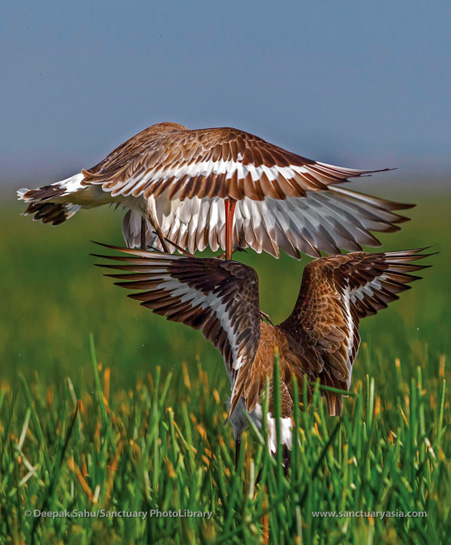
Family Feuds
Author:
First published in Sanctuary Asia,
Vol. 36
No. 2,
February 2016
Intraspecific aggression takes place when individuals of the same species clash to compete for mates, food, territory… perhaps even such resources as a waterhole in which to cool off in summer. This is different to interspecific competition, which takes place when different species compete for a common resource, for instance water in a shrinking pond, or a kill by a leopard that is claimed by either a tiger, or wild dogs. Essentially, it is the coding built into their genes that drives their instincts.
As is the case with economics, all resources are essentially scarce and such scarcity is what keeps populations in check. Such intraspecific competition may seem violent, or even cruel to us, but such dominance is key to the survival of the fittest on Planet Earth.
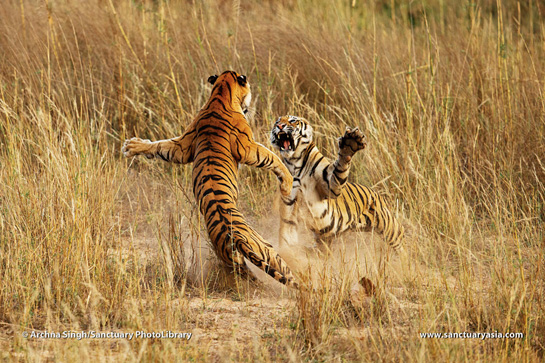
“Animals are aggressive not because they are savage, or bestial or evil (those are words with very little explanatory power) but because such behaviour provides food and defence against predation, because it spaces out the population and avoids overcrowding, because it has adaptive value." - Carl Sagan, Shadows of Forgotten Ancestors
Photographer: Archna Singh
Location: Bandhavgarh Tiger Reserve, Madhya Pradesh; Camera: Canon EOS-1D C, Lens: Canon EF 200-400 mm. f/4L IS USM, Shutter speed: 1/500 sec., Aperture: f/4.5, ISO 1250, Focal length: 325 mm. Image taken: May 5, 2014; 6:09 a.m.
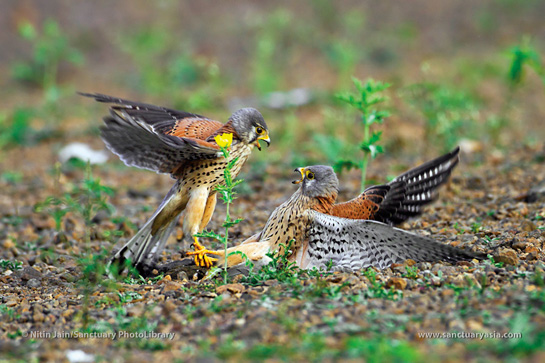
"Animals use aggression as a technique for gaining control over necessities... that are scarce or are likely to become so... They intensify their threats and attack with increasing frequency as the populations around them grow." - E.O. Wilson
Common Kestrel
Photographer: Nitin Jain
Location: Veer Dam, Pune; Camera: Canon EOS 7D, Lens: Canon EF 500 mm. f/4L IS USM, Shutter speed: 1/800 sec., Aperture: f/5, ISO 400, Focal length: 500 mm.
Image taken: January 3, 2015; 5:17 p.m.
“Each individual and each social group is prepared to resort to force, and to exert force to the utmost, if necessary, in order to defend its interests. Defensive fighting pays." - Wallace Craig, International Journal of Ethics
Western Black-Tailed Godwit
Photographer: Deepak Sahu, Entry - Sanctuary Wildlife Photography Awards 2015
Location: Mangalajodi, Odisha; Camera: Canon 60D, Lens: Canon EF 400 mm. f/5.6L USM, Shutter speed: 1/2500 sec., Aperture: f/7.1, ISO 800, Focal length: 400 mm.
Image taken: January 10, 2015; 12:28 p.m.
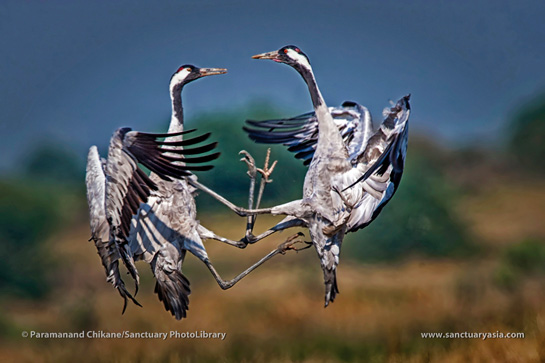
“Even when an animal does fight he aims, not to destroy the enemy, but only to get rid of his presence and his interference." - Wallace Craig, International Journal of Ethics
Common Crane
Photographer: Paramanand Chikane
Location: Little Rann of Kutchh, Rajasthan;Â Camera: Nikon D3, Lens: Nikon 600 mm. f/4.0, Shutter speed: 1/1250 sec., Aperture: f/8, ISO 320, Focal length: 850 mm. Image taken: December 11, 2014; 2:32 p.m.
“The danger of too dense a population of an animal species settling in one part of the available biotope and exhausting all its sources of nutrition and so starving can be obviated by a mutual repulsion acting on the animals of the same species… This, in plain terms, is the most important survival value of intraspecific aggression." - Konrad Lorenz
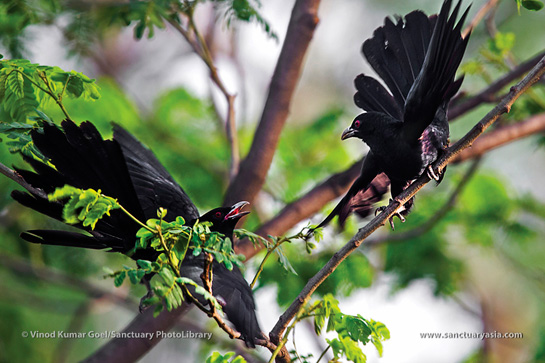
Asian Koel
Photographer: Vinod Kumar Goel
Location: Sunder Nursery, New Delhi; Camera: Canon EOS-1D X, Lens: Canon EF 600 mm. f/4L IS II USM+1.4x III, Shutter speed: 1/250 sec., Aperture: f/5.6, ISO 1000, Focal length: 840 mm. Image taken: May 10, 2014; 6:36 a.m.
 “And this leads me to say a few words on what I call Sexual Selection. This depends, not on a struggle for existence, but on a struggle between the males for possession of the females; the result is not death to the unsuccessful competitor, but few or no offspring." - Charles Darwin, The Origin of Species
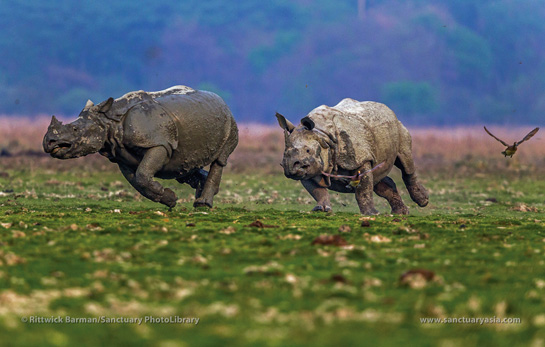
Great Indian one-horned rhinoceros
Photographer: Rittwick Barman
Location: Pabitora Wildlife Sanctuary, Assam; Camera: Canon EOS-1D Mark IV, Lens: Canon EF 500 mm. f/4L IS II USM+1.4x, Shutter speed: 1/2000 sec., Aperture: f/5.6, ISO 1000, Focal length: 700 mm. Image taken: March 25, 2014; 3:27 p.m.
“The notable thing about animal fights is that they are formal tournaments, played according to rules like those of boxing or fencing. Animals fight with gloved fists and blunted foils. Threat and bluff take place of deadly earnest." - Richard Dawkins
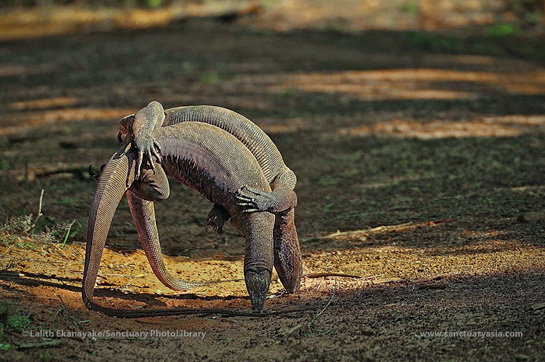
The Selfish GeneBengal monitor lizard
Photographer: Lalith Ekanayake, Entry - Sanctuary Wildlife Photography Awards 2015
Location: Bundala National Park, Sri Lanka;Â Camera: Nikon D35, Lens: Nikon 70-200 mm. f/2.8, Shutter speed: 1/640 sec., Aperture: f/5.6, ISO 320, Focal length: 400 mm.
Image taken: January 16, 2015; 8:45 a.m.
 “Two canine animals in a time of dearth, may be truly said to struggle with each other which shall get food and live." - Lyall Watson, Dark Nature
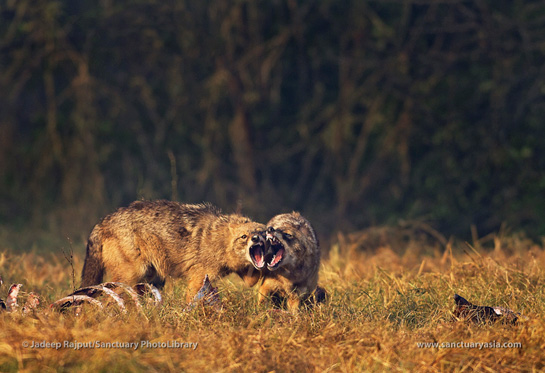
Golden jackal
Photographer: Jagdeep Rajput
Location: Keoladeo-Ghana, Rajasthan;Â Camera: Canon EOS 7D, Lens: Canon EF500 mm. f/4.5L USM, Shutter speed: 1/800 sec., Aperture: f/5, ISO 250, Focal length: 500 mm.
Image taken: January 13, 2011; 8:57 a.m.
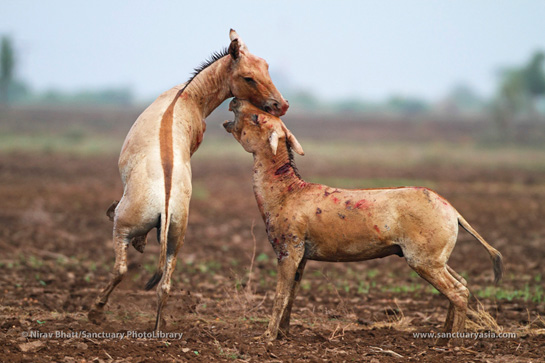
 “It is a universal rule that a social organisation comes about through aggression, usually fighting. As the individualslearn their position within the social group the intensity of aggression wanes." - Allen W. Stokes
Asiatic wild ass
Photographer: Nirav Bhatt
Location: Sundernagar, Gujarat;Â Camera: Canon EOS 7D, Lens: Canon EF 500 mm. f/4L IS USM, Shutter speed: 1/320 sec., Aperture: f/4, ISO 250, Focal length: 500 mm.
Image taken: July 14, 2011; 6:44 p.m.
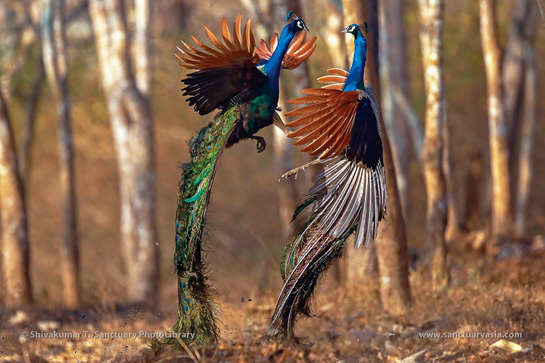
“Males that conquer other males leave more offspring than those conquered."Lyall Watson,
Dark NatureÂ
Indian Peafowl
Photographer: Shivakumar T.
Location: Bandipur Tiger Reserve, Karnataka;Â Camera: Canon EOS 5D Mark III, Lens: EF 500 mm. f/4L IS II USM, Shutter speed: 1/3200 sec., Aperture: f/4, ISO 640, Focal length: 500 mm.
Image taken: February 10, 2015; 5:51 p.m.
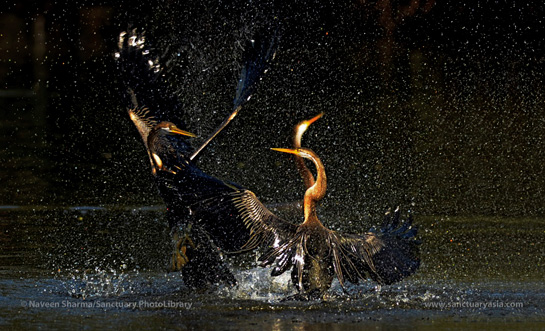
 “Living things are designed to do things that enhance the chances of their genes or copies of their genes surviving and replicating." - Matt Ridley, The Origins of Virtue
Oriental Darter
Photographer: Naveen Sharma, Entry - Sanctuary Wildlife Photography Awards 2015
Location: Keoladeo Ghana, Rajasthan; Camera: Nikon D7000, Lens: Nikon 300 mm. f/4 AF-S, Shutter speed: 1/1250 sec., Aperture: f/4.5, ISO 400, Focal length: 300 mm. Image taken: January 26, 2013; 4:06 p.m.
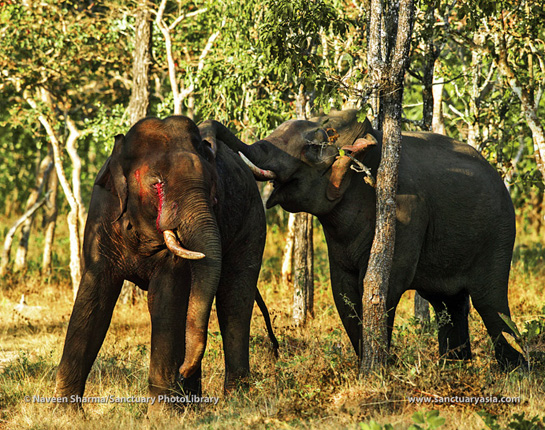
“To a survival machine, another survival machine (which is not its own child or another close relative) is part of its environment, like a rock or a river or a lump of food. It is something that gets in the way, or something that can be exploited. It differs from a rock or a river in one important respect: it is inclined to hit back. This is because it too is a machine that holds its immortal genes in trust for the future, and it too will stop at nothing to preserve them." - Richard DawkinsÂ
Asian elephant
Photographer: Mayank Mishra
Location: Kabini, Karnataka; Camera: Nikon D4 Lens: Nikon AF-S NIKKOR 500 mm. f/4G ED VR, Shutter speed: 1/100 sec., Aperture: f/8, ISO 500, Focal length: 17 mm. Image taken: January 6, 2014; 9:05 a.m.
First appeared in: Sanctuary Asia, Vol. XXXVI No. 2, February 2016.