Five Elephants Killed In Train Collision At End Of May
Author:
First published in Sanctuary Asia,
Vol. 33
No. 6,
June 2013
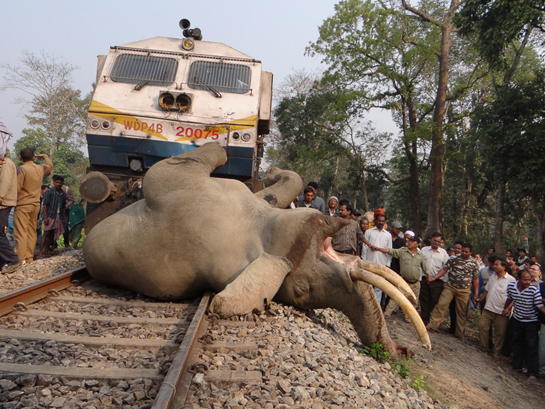 Photograph by Kaushik Sen.
WWF-India collected data on elephant deaths on the railways in North Bengal between 1974 (two years after passage of the Wildlife Protection Act), and 2002. Heerak Nandy, a co-petitioner in a suit to change railroad practices that is currently on file, has compiled all data since 2002. Elephant deaths on India's railways occur in many parts of the country, but North Bengal has the highest state mortality rate.
The latest tally of elephant fatalities was released by WWF-India on June 12, 2013. The data indicate that from 1974 to 2002, there were 27 elephants deaths in the region due to train accidents, and 45 fatalities between 2004 and 2013. The worst recorded accident occurred on September 23, 2010, when eight elephants were killed in a single collision.
The sharp increase in fatalities can be attributed in part to the conversion from meter gauge to broad gauge rail tracks between 2002 and 2004. WWF-India had fought the conversion in the courts in 2000, but lost. The conversion allowed passenger and goods trains to travel at 90 km/hour through elephant habitat and migratory routes, across some of India's most heavily forested areas. The data also reveal that nearly 87 per cent of the elephant fatalities occur between dusk and dawn.
A new public interest litigation (PIL) suit has been filed against the railways by Shakti Banerjee of WPSI and five others, requesting the rail companies take steps to mitigate the dangers posed to elephants. The suit is awaiting action by the High Court of Calcutta.
Colonel Banerjee, Honorary Director of WPSI and a co-petitioner in the case currently before the Calcutta court, said: "The number of elephant deaths due to collision with trains in N. Bengal has gone up five times since the conversion of the railway track from meter to broad gauge. It is a really alarming situation. We hope that the railways will take appropriate steps in the interest of conservation."Â
Data on N. Bengal elephant rail accidents, 1972-June 12, 2013
Author: Jennifer Scarlott, Source:Â WPSI, Shakti Banerjee, WWF India.

