Forest Connectivity Critical To Prevent Extinction, Say Scientists
Author:
First published in Sanctuary Asia,
Vol. 36
No. 8,
August 2016
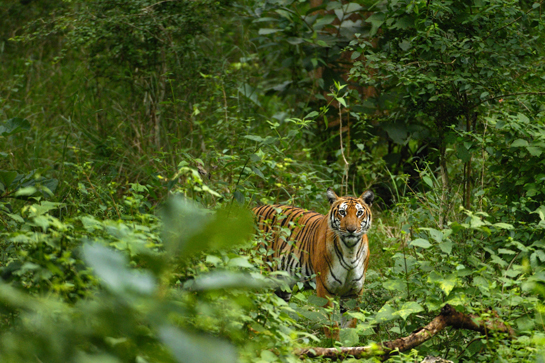 Photo: Kalyan Varma.
“Across species, and across geographies, whether you are looking at genetic material, population growth rates, or communities, the answer is the same - as connectivity erodes, species lose out," says Dr. Robert Fletcher, lead author of the study and Associate Professor at the Department of Wildlife Ecology and Conservation, University of Florida.
As connectivity is lost, genetic variability declines. Consequently, animals are less able to adapt to new environments, more prone to diseases, and can suffer from low survival and reproduction. Ultimately, local extinctions may occur, leaving behind depauperate animal communities and collapsing ecological systems.
“In India, Protected Area sizes are small, and landscapes are rapidly changing", says Dr. Divya Vasudev, Wildlife Conservation Society (India). “Still we have little knowledge of the consequences on our biodiversity".
Even for a species that is well studied, like the tiger, we are only now acquiring empirical knowledge on the role that connectivity plays in preventing its extinction. Potentially dispersing tigers have been removed into captivity from conservation landscapes.
The country is immersed in debates and court cases on the construction of National Highways across recognized tiger corridors. “If we had a better handle on the consequences of disrupting connectivity between tiger populations, maybe it would prompt more effective mitigative action", adds Dr. Vasudev.
Connectivity research provides practical insights to specific negative implications of habitat fragmentation on wildlife.
The authors recommend focusing on estimating connectivity effects, capturing movement processes, accounting for uncertainty and isolating connectivity effects relative to others. This will enable immediate on ground action needed to ensure that functional linkages are maintained between habitat patches, and further fragmentation is immediately and effectively curtailed.
The paper titled ‘Divergent perspectives on landscape connectivity reveal consistent effects from genes to communities' was published in the journal Current Landscape Ecology Reports last month. Authors include Robert J. Fletcher, Noah S Burrell, Brian E. Reichert, Divya Vasudev, and James D. Austin.
The paper can be accessed here: http://link.springer.com/article/10.1007/s40823-016- 0009-6
Source: Wildlife Conservation Society India Program

