From 411 To 523, Asiatic Lion Population Rises By 27 Per cent
Author:
First published in Sanctuary Asia,
Vol. 35
No. 5,
May 2015
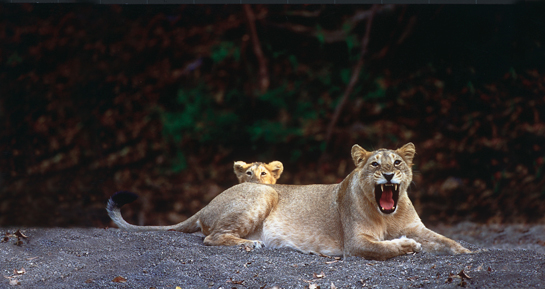 Photo: Hira Punjabi.
Gujarat Chief Minister Anandiben Patel quoted that the census records 109 adult males, 201 adult females and 213 sub-adults and cubs have been counted within Gir as well as in the nearby forests. The Gir National Park and Wildlife Sanctuary (GNPWS) now also covers double the area than in 2010 with 22,000 sq. km. that stretches over eight districts in Saurashtra region. There are 268 lions in Junagadh, 44 in Somnath, 174 in Amreli and 47 in Bhavnagar districts as per the census distribution. The maximum increase in population was found in Amreli, which have now dispersed to connecting districts.
Improved techniques and apparatus were also used to conduct the census such as a Global Positioning System (GPS), Geographic Information System (GIS), camera traps and digital cameras. Total block counting was also performed which is based on direct sightings. Tracking and taking note of pug marks were not conducted. Specific physical characteristics such as facial scars, ear shape, tufts of hair on the tail, colour and belly folds were taken into account. This information combined with location details was used to reach the final count. About 2,500 people that included wildlife experts and volunteers were involved in this enumeration exercise.
Several factors that include rescue, habitat mitigation, water management, man-animal conflict mitigation and creating awareness among the locals have contributed to the population increase. However, there are still challenges that pose a threat to the safety of these lions. Environmentalists have recorded that 40 per cent of lions live outside Protected Areas (PAs) while 260 lions have died in the past five years. Man-made structures like open wells, live wires on farms, poachers, passing trains and trucks make lions vulnerable in areas outside the PAs. Although there has been an alleviation of man-animal conflict, 14 people have been killed by lions while, 114 have been wounded in the past two years.
The increasing population has led the state government to consider establishing a new reserve of 109 sq. km. about 70 km. away from GNWPS. This will not only serve as a home to some lions, but also as a corridor along the Shatrunj river bank, allowing them to establish newer territories near Bhavnagar and Amreli regions. The Asiatic lion along with the Bengal tiger, Indian leopard, snow leopard and clouded leopard are the five big cat species found in India.

