Giri’s Bronzeback Tree Snake
Author:
First published in Sanctuary Asia,
Vol. 36
No. 6,
June 2016
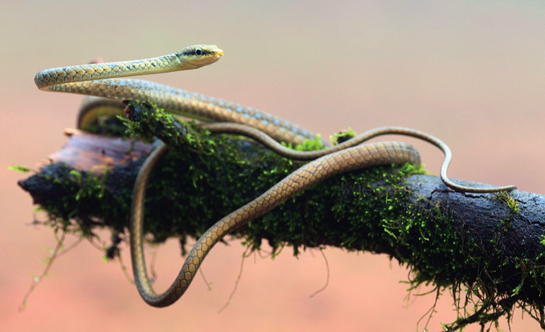 Photo: Ashit Vyas.
The snake in the photograph below is engaged in a threat display. By puffing out its body it has revealed blue markings that would normally be hidden behind a drab brown colour that serves it well when it needs to be camouflaged. Camouflage allows it to get close enough to catch its prey and reduces the chances of it being spotted by a predator. But in this pose, the snake is ready to scare away the threat and hence flashes its bright blue colours.
The large eyes and slim body of this snake will have it narrowed down by most snake enthusiasts to a common bronzeback tree snake. But its tongue is red. Common bronzebacks have a blue-black tongue. Painted bronzebacks found in Malaysia and northeastern India have red tongues like this snake. But this snake wasn't found in any of these places. A colleague of mine, Deepak, rescued it from human habitation close to the Cotigao Wildlife Sanctuary in Goa. Hence we identified it as the Giri's bronzeback tree snake. Incidentally, the Giri's bronzeback was for the longest time referred to as the painted bronzeback, until it was accorded with a species name of its own. It also has a trademark short, black-coloured stripe behind the eye. The snake has only been found in Western Ghats habitats in Karnataka, south Goa and Maharashtra.
The name Giri comes from Varad Giri, who is a Post-Doctoral Fellow at the National Centre for Biological Sciences, Bengaluru. Giri, a Sanctuary Wildlife Service Awardee in 2015, has been working on documenting the distribution and diversity of amphibians and reptiles in the Western Ghats and his efforts have already resulted in the discovery of several news species of snakes, geckos, frogs and caecilians from India. Amongst his list of achievements, the rediscovery of the Jeypore Indian gecko after 135 years, the description of 13 new species of frogs of the genus Nyctibatrachus, and the first report of a live-bearing amphibian Gegeneophis seshachari from Asia, stands out.
In behaviour, the Giri's bronzeback is no different from the common bronzeback. It is extremely fast and quick to strike threatening poses when cornered. But just like the common bronzeback, it rarely follows through on its threats with an actual bite! Like the common bronzeback, the Giri's bronzeback possesses excellent eyesight and will notice the slightest movement. Even the tiniest wriggle of a finger a foot away from the snake will have it bobbing its head from side to side as it accurately tracks the movement.
This slender snake very frequently climbs trees and other lofty areas that most other snakes would have much difficulty reaching. In addition, it has the ability to spring from one branch to another and its notched belly scales are well designed to give it good grip while climbing.
Not much is known about the Giri's bronzeback tree snake, except that it feeds on agamids, geckos, frogs, and small birds.
Author: Rahul Alvares, First appeared in: Sanctuary Asia, Vol. XXXVI, No. 7, July 2016.

