Government Plans To Widen NH7 Highway Suspended
Author:
First published in Sanctuary Asia,
Vol. 35
No. 5,
May 2015
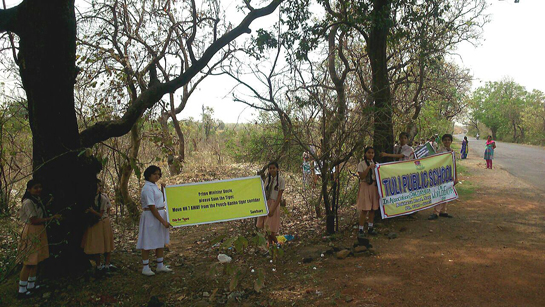 Photo Courtesy: Jaideep Das.
The Maharashtra government had requested the head of forest force (HOFF) for permission to commence felling of trees which was received within less than a day. However, commencement had occurred without the proper final approval (Section 2, FCA 1980). A meeting was held that rejected mitigation plans by Wildlife Institute of India (WII), Dehradun, while accepting plans by the NHAI to construct 50 metre underpasses for wild animals in corridor patches. This did not go down well with environmentalists, who demanded WII submit a revised mitigation plan. Later, the NGT had released an order stating, “no non-forest activity in the forest area that is covered under Section 2 of the FCA would be permitted and carried in any manner unless an order is passed by the competent authority of that state government and put in public domain on its website and complying with other requirements in accordance with law." The forest department had also written to the state government stating that the permission granted to them for felling the trees on NH7 was illegal and requested them to retract it.
Furthermore, the Supreme Court has suggested that the National Board for Wildlife (NBWL), who had not given their permission for road widening plans consider revising the proposal by NHAI. On the other hand, alternate measures suggested by the government's top wildlife institute itself have been ignored. This takes into account the option to use an alternate route via Seoni - Chhindwara while trying to alleviate the forest patches that connect Satpuda, Bori, and Pench Tiger Reserves.
There are many consequences to the expansion of the road that would affect forests of Madhya Pradesh and Pench Tiger Reserve on Maharashtra. It will also destroy wildlife corridors between tiger reserves including Kanha and Pench Tiger Reserve, and Mansinghdeo Wildlife Sanctuary and Navegaon-Nagzira Tiger Reserve (NNTR).
Source: The Times of India.

