Highlights From The CITES Meeting 2016
Author:
First published in Sanctuary Asia,
Vol. 36
No. 9,
September 2016
CITES is a legally binding agreement which aims to ensure that international trade in specimens of wild animals and plants does not threaten their survival. It does so by monitoring, listing and regulating legal and sustainable wildlife trade and by combating illegal trade in wildlife. It currently regulates trade in over 35,000 species of wild animals and plants.
“The stakes are high under CITES and intense and robust debates are to be expected. Decisions taken in Johannesburg will have a real and immediate on-the-ground impact. They will find their way into legislation, regulation, and operating practices across the globe and will directly affect when, where and how wildlife and wildlife products can be traded. Decisions taken here at CoP17 will affect wildlife and ecosystems, people and economies," said John E. Scanlon, Secretary General of the Convention.
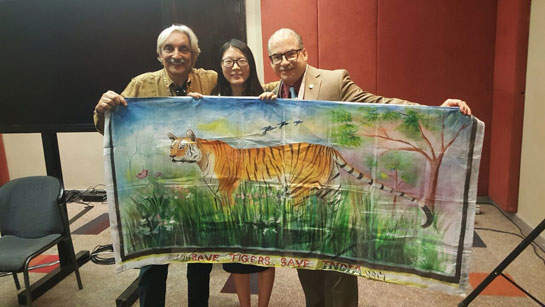
Sanctuary Editor Bittu Sahgal is also participating in the conference, and has carried a message from Kids for Tigers in Assam to all the delegates. The large, hand-painted tiger banner by Tezpur Tiger Ambassador Madhurjya Nath calls on participants to 'save tigers to save India', and is a symbol of solidarity between India's children and children across the world who are concerned about biodiversity conservation.
Here are some highlights from the meeting so far:
Parties propose listing sharks and rays under CITES Appendix II. In the Committee session nine devil rays, three thresher sharks and the silky shark species were proposed to be listed under the CITES Appendix II. This would ensure international trade restrictions on over-fishing and export. "We are elated by the resounding support for safeguarding the devil rays, some of the oceans' most vulnerable animals," said Sonja Fordham of Shark Advocates International.
African Grey Parrot to be listed under CITES Appendix I. Parties to CITES have upgraded the African Grey Parrot's Appendix II status to Appendix I, which will enforce a global ban on the international commercial trade of the bird. "Inclusion in Appendix I is in the best interests of the conservation of the species as it faces both habitat loss and rampant illegal and unsustainable trade for the international pet trade, " said Susan Lieberman, Wildlife Conservation Society, VP of International Policy and head of the WCS delegation at CITES.
Total ban on international trade of pangolins! A proposal to enhance protection for all eight pangolin species that was put forth by India and the United States of America was agreed upon by the members of a CITES subcommittee. Pangolins are believed to be the world's most-trafficked animals, and several sub species are being forced to extinction. With this move, all eight species of pangolins are set to be moved to Appendix I of CITES, which means a ban on international trade and stiffer penalties for those caught violating the ban. The listing will become official on the last day of the Conference, when it will be formally adapted by the Plenary.
CITES addresses issues of corruption. For the first time in history, a draft resolution, submitted by the European Union and Senegal, addresses activities conducted in violation of the Convention. Among other things, the resolution mentions the need to develop anti-corruption strategies and urges all member states to integrate their commitment to CITES with other international conventions. Said Susan Lieberman, Head of the Wildlife Conservation Society's CITES CoP17 delegation: "WCS strongly supports the draft resolution on corruption, submitted by the European Union and Senegal. We welcome the fact that, for the first time in its more than 40 year history, the CITES is finally grappling with the scourge of corruption. Corruption at all levels facilitates wildlife crime, and undermines the rule of law, good governance, and sustainable development. In particular, we support the integration by States of their obligations under CITES with their obligations under both the UN Convention Against Corruption (UNCAC) and the UN Convention against Transnational Organized Crime (UNTOC)."
Laos PDR commits to phasing out tiger farms. Such commercial tiger breeding enterprises are a huge obstacle in the way of tiger conservation as they create demand for tiger-derivative products. Laos' announcement is a step in the right direction, however much is to be done. Debbie Banks, Head of EIA's Tiger Campaign, said: “If the Minister invites international technical experts to assist with an audit of tigers and facilities and the development of a phase-out plan, it would put Laos streets ahead in implementing CITES measures to end tiger farming."
Discussion on establishing process for future ivory trade rejected. A nearly decade-long discussion on creating a ‘decision-making mechanism' (DMM) to establish a process for trade in ivory was brought to an end, but with mixed feeings. Three African nations - Namibia, South Africa and Zimbabwe, had put forth a proposal for the DMM to be established, while eight other nations had countered the proposal with a call for discussion on the subject to be abandoned. Ultimately, the CITES Standing Committee held a vote on whether the DMM discussion should be extended. The majority decision was to end discussions. The poaching of African elephants has reached a crisis point, and Sanctuary Asia urges for a complete, global ban on ivory trade and sale. From the beginning of 2007 to the end of 2015, the continent has seen a net decline of more than 110,000 elephants.
Conservationists ring alarm bells for Ploughshare tortoise. A coalition of conservation organisations comprising the Wildlife Conservation Society, the Durrell Wildlife Conservation Trust, the Turtle Survival Alliance and the Turtle Conservancy, released a joint statement to the governments attending the conference. They warned that the critically endangered Ploughshare tortoise that is endemic to Madagascar will go extinct in the wild if poaching pressures continue apace. It is estimated that less than 100 adults of the species remain in Baly Bay National Park, their only home. The organisations have called for immediate action to halt the trafficking of the species.
Standing Committee admonishes Vietnam for rhino horn trade. Vietnam is globally recognised to be the biggest market for rhino horns. This has devastated rhino populations across Africa, with an estimated 1300 rhinos poached annually to meet market demands. The CITES Standing Committee warned Vietnam that it will not tolerate the country's inability to enforce bans on the rhino horn trade. The warning implies that Vietnam may be subject to trade sanctions if it does not crack down on the trade.
Indonesia calls attention to the plight of the Helmeted Hornbill. A critically endangered species that is listed under Appendix I of CITES, the Helmeted Hornbill's casque is traded as a substitute for ivory. The bird's population has plummeted as poachers target it for international trade. At CoP17, Indonesia is calling on both range states and consumer states (primarily China) to step up trans-boundary law enforcement efforts. The agenda document submitted by Indonesia on the matter can be read here.
We will be updating this page as and when new resolutions are adopted and decisions taken at COP17. The conference runs from September 24 to October 5, 2016.

