Human Footprint Limits Elephant Distribution In Western Ghats: WCS Study
Author:
First published in Sanctuary Asia,
Vol. 35
No. 7,
July 2015
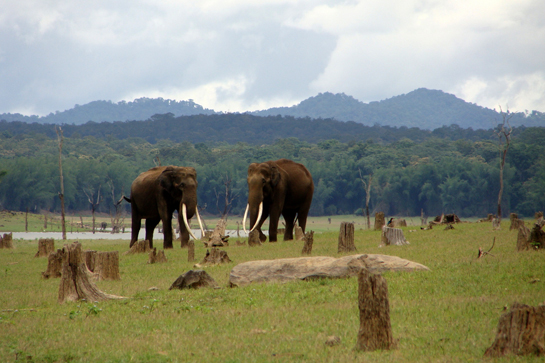 Photo: Nishant M. Srinivasaiah.
Bengaluru: The Western Ghats forms the last stronghold for our National Heritage Animal, housing the world's largest population of Asian elephants. Nevertheless, today, less than half of this landscape is occupied by elephants, a pattern largely driven by an increased human footprint, new research by Wildlife Conservation Society, India Program says.
Across India, little reliable information exists on the status of Asian elephant populations. Without accurate information on elephant spatial distribution or population size, it is impossible to effectively conserve the species, particularly in the face of increasing habitat loss, conflict with humans and poaching. “Many methods used to assess elephant distribution today, for instance, ‘presence-only' methods, can be highly inaccurate. What we use in this study is a vast improvement, and is easily applicable over large landscapes, in addition to being reliable", said Dr. Karanth, Director for Science - Asia, WCS, and co-author of the study.
Using an occupancy sampling and modelling approach that fully addresses problems ubiquitous in field survey data,scientists at WCS India and Centre for Wildlife Studies mapped elephant distribution across the 38,000 km2 Malenad landscape. The study was part of a larger initiative aimed at assessing tiger and prey distribution across the landscape, and was conducted in collaboration with the Karnataka Forest Department. “This method takes into account the simple fact that we may not actually end up seeing elephants—or signs of their presence—even if they are present at a location", explained Devcharan Jathanna, lead author of the study.
“We found that human presence played a key role in determining where elephants were found, much more so than environmental attributes", said Mr. Jathanna. Only 64% of the 21,000 km2 of ‘elephant habitat' in the landscape was occupied by elephants, emphasizing this point. The study underscores the need for strict regulations to secure this critical landscape. Importantly, the research establishes a reliable protocol to study elephant distribution, one that can be used by governmental and non-governmental agencies engaged in elephant conservation throughout their range.
The study by Devcharan Jathanna, Dr. K. Ullas Karanth, Dr. N Samba Kumar, Dr. Krithi K. Karanth and Dr. Varun R. Goswami of WCS India was published yesterday in the reputed international scientific journal ‘PLoS One'. This study closely follows another recent WCS India publication that demonstrated a reliable approach to monitor elephant populations in key protected areas,which appeared earlier this year in the leading conservation journal Biological Conservation.
“Karnataka is at the forefront of applying current methodology to study and conserve wildlife", added Dr. Karanth, urging the rest of the country to follow suit. These techniques can greatly advance our understanding of the status and distribution of endangered species, including the Asian elephant, devise more effective conservation strategies, and monitor the efficacy of their implementation.
For more details, please contact: Dr. VarunGoswami: +91 99019 43676; varunr.goswami@gmail.com
First published in: Sanctuary Asia.

