Hundreds Of Young People Arrested At White House Protesting Keystone XL Pipeline
Author:
First published in Sanctuary Asia,
Vol. 34
No. 3,
March 2014
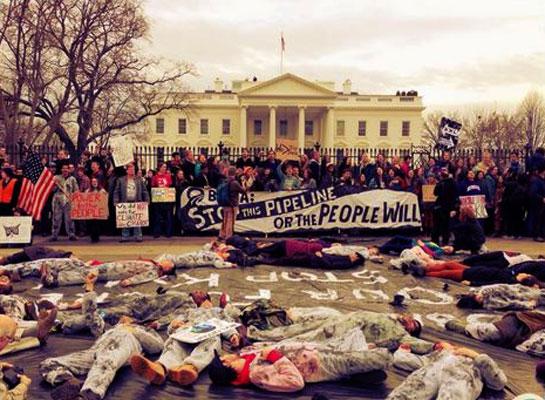 Photo: Jenna Pope.
Sunday's action, called XL Dissent, is a massive surge of protest against the Keystone XL tar sands pipeline and represents a growing movement of American young people who are concerned about climate change and its future global impacts. XL Dissent came together as a powerful show of support for communities that are on the front lines of the fight against the fossil fuel industry and that are experiencing first-hand the impacts of the climate crisis.
Bill McKibben, co-founder of the global climate group 350.org, said of XL Dissent, “An entire movement has thrown itself into this Keystone fight, from local frontline groups to big, national, green organizations. But this weekend shows the power and bravery of some of the most crucial elements: young people, and activists who understand the centrality of environmental justice."
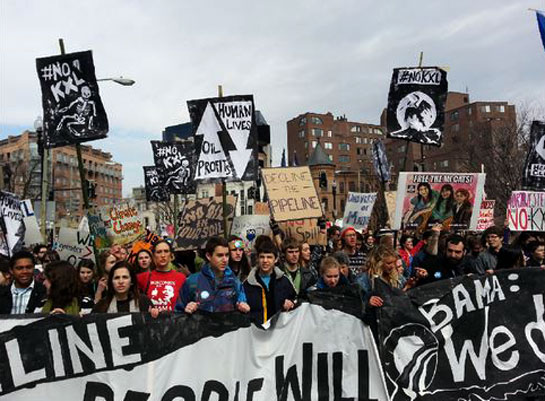 Photo: Occupy Wall Street NYC.
The students held a series of meetings and trainings during the weekend to prepare for Sunday's march and peaceful civil disobedience. On Sunday morning, they gathered 1,000 strong on the grounds of Georgetown University where President Obama promised last June that he would only approve the pipeline if it didn't significantly increase greenhouse gas emissions. The President is expected to make his final decision within 60 days.
The students then marched through the streets, stopping in front of the home of Secretary of State John Kerry and unfurling a giant mock oil spill in the middle of the street. Secretary Kerry must make a recommendation to the president about the pipeline. The 1,700-mile Keystone pipeline would originate in the tar sands of Alberta, cross the Canadian border and proceed down the mid-section of the United States to the Gulf of Mexico. Opponents have opposed the building of the pipeline for years, citing the enormous contribution to climate change that continued mining of the Canadian tar sands will make, and the concerns about oil spills and environmental damage that will occur along the pipeline's length to local communities, and to the massive Ogallala aquifer in the center of the U.S.
“Obama was the first president I voted for, and I want real climate action and a rejection of the Keystone XL pipeline," said Nick Stracco, a senior at Tulane University and one of the lead organizers of XL Dissent. “The people that voted him into office have made it absolutely clear that we want him to reject Keystone."
From Secretary Kerry's home, the protesters marched to the White House in central Washington. After hearing from speakers, including young indigenous leaders, representing communities that will be directly affected by the pipeline, the young people moved with a resounding cheer from Lafayette Park to the fence surrounding the White House. There, hundreds of youth secured themselves to the fence with plastic handcuffs, while others spread out a giant black tarp representing an oil spill, throwing paper mache birds and animals on the tarp before lying down on it themselves in a mass die-in. Police moved in to cordon off the protesters as a large crowd of media filmed the event.
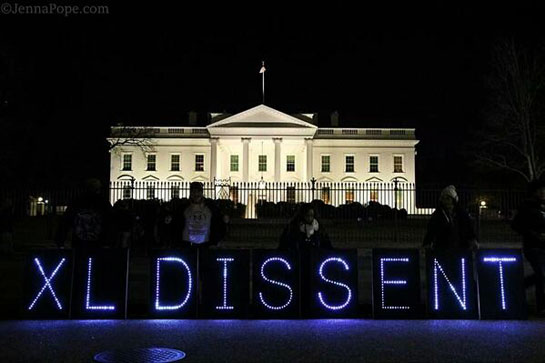 Photo: XL Dissent.
In all, 398 young people chose to be arrested in peaceful protest of the Keystone pipeline. 350.org co-founder Bill McKibben noted the irony of the number, pointing out that 398 arrested youth precisely corresponds with 398 parts per million of carbon dioxide in earth's atmosphere, a number that is rising as carbon pollution continues to wreak climate havoc.
According to Jamie Henn, a 350.org organizer, “There have been a lot of protests against the Keystone XL pipeline, but XL Dissent had a new sense of energy, determination, and excitement. This movement isn't going away, it's getting stronger by the day. More than 70,000 people have now signed on to the Keystone XL Pledge of Resistance to show that they are willing to engage in civil disobedience if President Obama moves forward with approving the Keystone XL pipeline. XL Dissent is helping cement that commitment and energize opposition to the project." In all, students from 80 colleges and universities in 42 states participated in XL Dissent.Â
Priyanka Ball, a student at Bryn Mawr College in Pennsylvania, explained her involvement in XL Dissent this way: “I'm from Bangladesh, and I've been working on climate change issues for a long time. I've seen people really suffer, people lose their homes to floods and hurricanes. I'm here to stop Keystone XL so they will have a place they can call home."
New Rhetoric From President Obama On Climate Change.
More Signs That Tar Sands Are A Bad Investment.
Author: Jennifer Scarlott.

