India’s First Dichromatic Snake Species Discovered
Author:
First published in Sanctuary Asia,
Vol. 37
No. 5,
May 2017
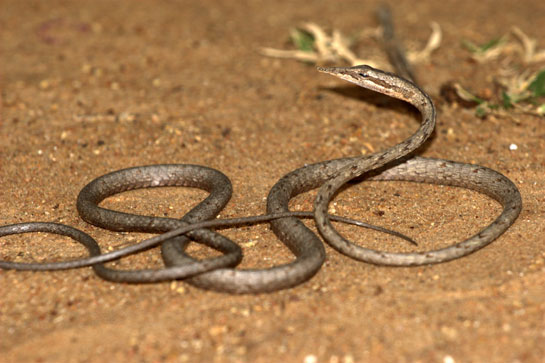 Photo: Gihan Jayaweera.
Prior to this discovery, the male and the female snakes were clubbed with the common vine snake and brown vine snake respectively. However, thorough molecular and morphological studies have brought to light a number of genetic variations, which validated the existence of an entirely new species. It has been named Ahaetulla anomala and is commonly known as the variable coloured vine snake.
The study was conducted by biologists, Pratyush Mohapatra, Prof S.K. Dutta, Niladri Kar, Abhijit Das, B.H.C.K. Murthy and V Deepak, after Mohapatra and Dutta first came across the snake near North Orissa University campus in Baripada (2007). According to their research paper published in Zootaxa, the specimen was similar to another species, A. pulverulenta, which is brown, had a rhomboidal mark on the head and had a dermal appendage covered with multiple scales. Later, both green and brown coloured snakes, with similar head markings were found in different locations in West Bengal, Jharkhand and Bihar and were kept in the repository with the Zoological Survey of India, Kolkata. “We had an inkling of the fact that we were dealing with something new the moment we saw similar head markings on different coloured snakes. Therefore, we decided to collect specimens from different locations in order to examine them in detail," said Professor S.K. Dutta. “However, finding specimens wasn't easy. It took us almost 10 years to conduct complete, scientific research," he explained.
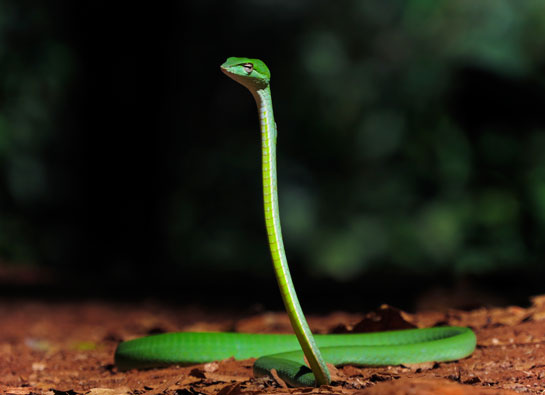 Photo: Shubham Darveshi.
The DNA analysis and morphological study revealed that the colour of the snake was a vital deciding factor in species differentiation and some of the specimens were wrongly catalogued as A. pulverulenta. “The complexity in snake species is a major factor as to why certain snakes can be wrongly identified. There are still quite a few species, especially in Odisha and northern India, where reptiles are wrongly catalogued or are undiscovered. We are studying them further and with increased scientific expertise and methods, we expect to correctly identify and validate more such species," said Professor Dutta.
This is the first time that sexual dichromatism within snakes has been observed in the Indian subcontinent.
Sources: Researchgate
Indian Express
Odisha Sun Times

