Is It The End Of The Line For The Great Indian Bustard?
Author:
First published in Sanctuary Asia,
Vol. 38
No. 11,
November 2018
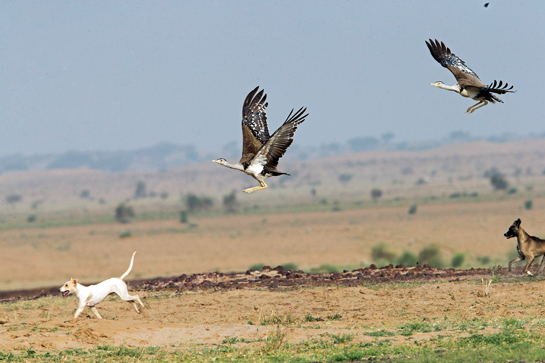 Photo: Dhananjay Joshi/Honourable Mention-The Sanctuary Wildlife Photography Awards 2018
The alarm bells for the GIB, a flagship species of the grassland ecosystem, have been ringing loud for over a decade now. In 1969, over 1,000 Great Indian Bustards roamed the country's grasslands. Today, with a global population of fewer than 150 individuals, the GIB is critically endangered, and in danger of extinction.
Already extinct from 90 per cent of its geographical range, fewer than 150 of these beautiful birds survive in the fragmented grasslands of Rajasthan and Gujarat, along with a few individuals surviving in Maharashtra, Andhra Pradesh and Karnataka.
How were they pushed to the brink? We ravaged their grassland habitat. We allowed them to be attacked by feral dogs. We indulged in well-intended, but ill-informed forestry practices by planting invasive tree species. We sprayed our fields with pesticides… and then, we imprisoned them within a network of wires.
Though many of these threats are now understood and attempts are being made to counter them, there is one swinging axe that could seal the bird's fate. The power transmission lines that crisscross GIB habitat are proving to be fatal for these low-flying, ground-dwelling birds. According to a study by the Wildlife Institute of India, 10 individuals have lost their lives in power line collisions in the last decade (2007-2017). Finding bustards, dead or alive, in their vast remote territory is next to impossible, which is why scientists fear that the on-ground mortality rate could be even higher!
The erection of power lines in and around GIB habitat is against the guidelines for the recovery of the species given by the Ministry of Environment, Forest and Climate Change. Unfortunately, the ‘wasteland' status of grasslands inhibits strict environmental scrutiny before the sanctioning of developmental projects. India's push towards renewable energy is laudable, but power transmission strategies need to be in line with this green vision. While private companies generate clean energy, it is up to India's Ministry of Power and Ministry of New and Renewable Energy to ensure that this energy reaches its destination without causing an extinction. The simple, if expensive, solution is to place these overhead transmission lines underground. Such an intervention has proved successful for the conservation of a similar bustard species, the Great Bustard, in West Pannonia. It's time India does the same!
The Great Indian Bustard has only one home.
India.
Will we hasten or halt its extinction?
Flight to Extinction We're protecting their land, but unless we make the skies safe too, the GIB will vanish within our lifetime. There is one solution. The overhead power transmission lines that threaten the survival of the Great Indian Bustard can be placed underground as has been done for other species in other countries. If we bury the power lines, we won't have to bury the Great Indian Bustard. Join us in asking the Ministry of Power to take action on this now! We can still save India's pride. Write to the Ministry of Power Shri Ajay Kumar Bhalla, Secretary, Ministry of Power
Email: secy-power@nic.in and Ministry of New and Renewable Energy Hon'ble Raj Kumar Singh, Minister of State-In Charge
Email: raj.ksingh@gov.in The need of the hour is one strong movement that brings conservationists, policy makers and the general public together in a concerted effort to halt the extinction of this incredible species. To this effect, Sanctuary will launch its Great Indian Bustard Campaign, in collaboration with The Corbett Foundation at the Sanctuary Wildlife Awards, on December 7, 2018, in Mumbai, and will make an earnest appeal to an audience of concerned citizens and conservationists. Sanctuary readers are encouraged to sign an online petition available on www.conservationindia.org |
First published in: Sanctuary Asia, Vol. XXXVIII No. 12, December 2018.

