Kudankulam Nuclear Plant Will Devastate Tamil Nadu Marine Life And Fisheries
Author:
First published in Sanctuary Asia,
Vol. 33
No. 8,
August 2013
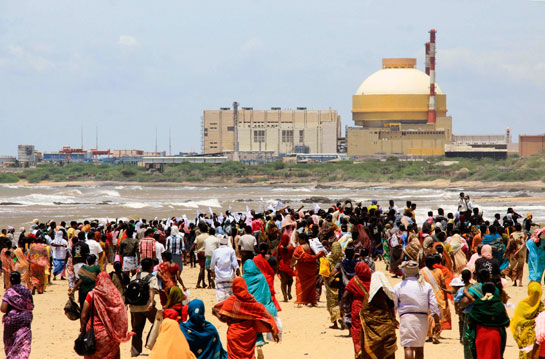 Photo: www.countercurrents.org.
Over the course of the past two years, challenges to the plant have been made by thousands of local people and by nuclear experts including A. Gopalakrishnan, former Chairman of India's Atomic Energy Regulatory Board, who have raised a wide array of concerns about the safe operation of the plant, and questions about nuclear power's viability post the Fukushima disaster in Japan. In addition to these concerns about human health and safety, environmentalists have underlined the devastation to Tamil Nadu's local environment and marine life that will be caused by the plant's normal daily operations.
An open channel running along the plant's seaside compound wall will dump 6.3 billion litres of hot, salty, toxic effluents into the Gulf of Mannar Biosphere Reserve each day. Dr. Mark Chernaik, scientific advisor to the U.S. branch of the Environmental Law Alliance Worldwide (ELAW-US), reviewed the Kudankulam Environmental Impact Assessment report and the response of the government's expert group, and concluded that, “… neither contains an adequate assessment of the impacts to marine life of cooling water (thermal) discharges."
Dr. Chernaik cited case studies from China and Brazil: “The impact to marine life of thermal discharges [from nuclear power plants] are… very substantial: small increases of the temperature of marine water changes water chemistry, including reductions in dissolved oxygen levels… that can deleteriously impact fisheries. Also, fish may be able to migrate to avoid localized temperature shifts, but their food sources (sponges, algae, and small invertebrates) are fixed and cannot."
The impact on local fisheries will be immediate and cumulative. A 2008 study for the Nuclear Power Corporation of India Ltd. (NPCIL) stated that ocean currents in the region flow parallel and close to the shoreline. During the monsoon, the currents flow east toward Idinthakarai. Between November and February, they reverse. The wastewater will kill all life in the inter-tidal zone in the immediate vicinity of the effluent channel, as well as seaward until the temperature can reach normal levels. Fish, prawns, and lobsters that feed on plankton will be heavily affected, since there will be massive plankton die-offs in the hot wastewaters. The nearby villages of Idinthakarai, Kootapulli, and Perumanal landed 14,000 tonnes of fish in 2010, at least half of which were sardines, a plankton-feeder.
The expert appraisal committee of the Ministry of Environment and Forests (MoEF) has raised questions about discharging such a large quantity of hot, polluted water onto the shores of the Gulf of Mannar, citing “adverse impacts on marine life."
Link to the published article: Criticality may mean death for Kudankulam's seas.
Author: Jennifer Scarlott.Â

