Lakshadweep Archipelago Feels The Heat
Author:
First published in Sanctuary Asia,
Vol. 36
No. 4,
April 2016
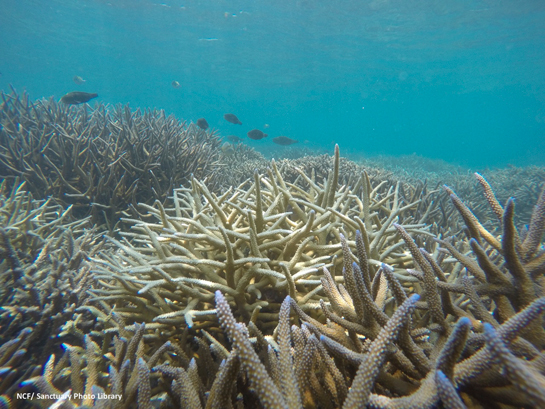 Photo: NCF/Sanctuary PhotoLibrary.
The current year is already turning out to be a bad one for coral reefs around the world. Across the Pacific, the El Niño Southern Oscillation has left a trail of dying and dead reefs, and the wires are full of worrying reports as scientists in Australia assess the full scale of the damage to the iconic Great Barrier Reef (GBR). Early indications, based on extensive aerial surveys conducted across the length of the GBR, suggest that more than 90 per cent of the reefs surveyed exhibit some sign of bleaching. These latest signs show that the current system may be weakening across the Indo-Pacific, and it is clear that 2016 will leave a definite signature on tropical reefs.
The Nature Conservation Foundation's Oceans and Coasts team has been tracking the progress of this event on the reefs of the Lakshadweep archipelago. These are reefs that have been hit by previous El Niño events - first in 1998, and again in 2010. While the 1998 event was devastating to the reefs, the Lakshadweep system showed a remarkable ability to bounce back from this event. Critical to this recovery was that the reefs of the Lakshadweep have, until recently, been very lightly fished, ensuring that populations of herbivores and top predators (both critical for the effective functioning of reefs after disturbances) were relatively intact. The recovery after the 2010 event has been less encouraging, and although we are a long way from understanding why recovery has not been as brisk in the wake of this second mortality event, it coincides with a recent uptick in reef fishing - potentially disastrous for the reef - and the overall bio-security of the low-lying Lakshadweep archipelago.
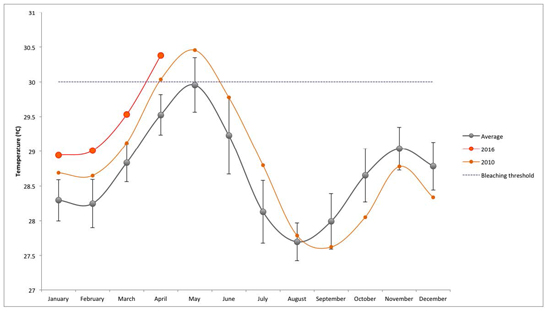
Against this backdrop, the ongoing observations of the NCF team are worrying to say the least. Sea surface temperatures are already soaring above critical bleaching thresholds and, for the first few months of 2016, the team has recorded temperatures that are higher than ever before (see Figure 1). In every reef that has been surveyed, corals have already begun to pale - the first sign of full-scale bleaching. By early April, some shallow lagoon sites were pallid and bleached, and many coral had already started dying from the heat stress.
Worse still, elevated sea surface temperatures along with unusually calm seas meant that temperatures in the first few metres of the reef were as high as 350C, the highest that the members of the team have ever experienced in these waters in the last two decades of diving here. At these temperatures, the water starts becoming seriously hypoxic for most fish, and respiration becomes increasingly difficult. In several of their surveys, the team recorded fish dying - most likely as a response to these elevated temperatures. They found scores of triggerfish, snappers, groupers and several other species either floating dead on the surface of the water, drifting close to the shore or, in some instances, dead on the reef.
Clearly these temperatures are unsustainable, but it will be several more weeks before the full extent of the bleaching can be understood. The NCF team is heading back to the islands in early May to evaluate the situation. Together with the Lakshadweep Department of Science and Technology, they plan to conduct rapid surveys of as many atolls as they can before the monsoons make sampling impractical. Quantifying how much of this bleached coral dies will require them to wait until the monsoon lifts and they can get back into the water later this year. How long before the reefs of the Lakshadweep can recover from this watershed event will require another decade or more of observation.
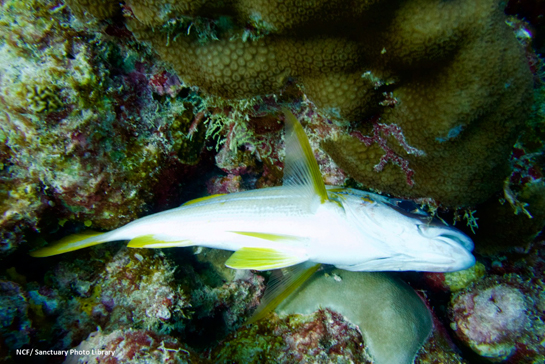 Photo: NCF/Sanctuary PhotoLibrary.
What is clear is that we can no longer expect our tropical reefs to provide the same ecological services that we once took for granted. These reefs have shown once before that they have the capacity to buffer and recover from even the worst coral mortalities as long as they are not heavily fished or polluted. These pre-conditions are already changing in the Lakshadweep, and we are already seeing an erosion of this essential buffer capacity. Ensuring that human communities can continue to live on these tiny slivers of coral sand for the next few generations will require some clear and urgent decision-making. Balancing the genuine growth aspirations of the Lakshadweep economy with the non-negotiable ecological limits placed by the reefs on which these islands depend will require far-thinking and creative leadership.

