Leopard Conflict On The Rise
Author:
First published in Sanctuary Asia,
Vol. 34
No. 7,
July 2014
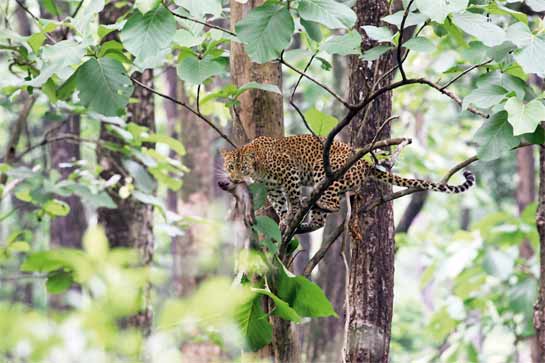 Photo: Suvamoy Changder.
India's ‘leopard problem' is a chronicle of a crisis foretold. Kailash Sankhala, the first Director of Project Tiger had warned the Indian Board for Wildlife that the spotted cat was being forced into unwelcome proximity with humans thanks to our mindless destruction of forests. Ironically, the leopard's prime survival assets - adaptability and stealth - are precisely what now places it and hundreds of its innocent human victims, in harm's way. Mayukh Chatterjee, Sheren Shrestha and P.C. Pandey, however, believe that there are ways to reduce the problems and lend more security to the lives of both man and animal. Mandar Sable reaffirms this through his heartening story of an amazing leopard rescue from Ahmednagar.
Earlier this year, a large adult male leopard found himself within the bustling north Indian city of Meerut. No one knows how long he had stayed hidden. When he was discovered in a small timber depot, a chain of events unfolded, laying bare several facts for us to think about and lessons to learn from about how to better handle similar future encounters. Unfortunately, increasing instances of large carnivore-human conflicts have got us nowhere close to finding a fool-proof solution.
When news of a leopard on the loose in the city spread, people gathered at the depot like iron filings to a magnet. The animal, however, managed to escape, clawing an over-enthusiastic visitor in an attempt to get away. The leopard was then found hiding in a nearby hospital. By now some 1,000 to 1,500 people had gathered, blocking the main entrance of the hospital, over-flowing over the roof and boundary walls, and generally scattered throughout and around the facility.
When the Wildlife Trust of India (WTI) team reached the venue, they were greeted by an extraordinary flood of flash lights in the hands of media personnel on duty to ‘get a piece of action'. Several hour-long efforts to isolate the animal within the hospital proved futile, as the burgeoning bystanders refused to clear out despite the efforts of the police and military personnel on duty. The public was not merely hounding the unfortunate leopard, but also the rescue team.
Understandably, the leopard was in a state of panic. In unfamiliar territory, surrounded by a hollering mob, it was only a matter of time before its threshold of desperation was crossed. In such situations, sedation and capture become even more difficult and extremely risky. The animal could die from a combination of its own adrenaline rush and the sedation drug administered. Also, in many cases the rescue personnel have themselves been injured.
As the noise and flashes continued, helpless and agitated, the leopard finally made its desperate dash for safety. Video footage later revealed that the cat had carefully weighed its options, and in a split second decision, trotted along a corridor and then took a leap crashing through a six to eight millimetre glass door and a cable-reinforced mesh wall, straight into the crowd. A few people tried foolishly to stop it, in vain. The leopard vanished into the city.
CCTV footage early next morning showed the leopard at a nearby shopping complex, crossing a road and passing people sleeping in the open. Cautiously avoiding the human silhouettes, the leopard managed to disappear again.
Five days went by as the rescue team scouted the city streets, chasing scores of false alarms. Verifying every report was a daunting task, but had to be undertaken, if only to keep people calm.
The hope was that after its traumatic experience, the leopard had exited the city for safer havens. But the search continued and then, five kilometres as the crow flies, northeast of the site of its first sighting, large pugmarks matching the size of the ones from the city, told a story of an animal that had, miraculously, given a slip to thousands of people using patchy Acacia and scrub outcrops for cover.
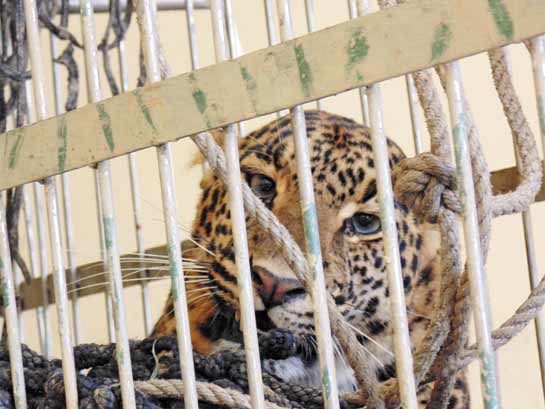 Photo: Mayukh Chatterjee.
THE CHALLENGE BEFORE US
Since the above incident, Meerut has witnessed two more leopards in its midst. One was rescued and released successfully. The other, however, died due to injuries from a leg-trap and severe dehydration.
If logic is anything to go by, these conflicts will only increase. Figures concur. Leopard-human conflict in Uttar Pradesh surged by almost 92 per cent in the five year period between 2006 and 2011, when compared to figures between 2000 and 2005.
It need not be this way. Hundreds of leopards and tigers, and sometimes humans, need not die. On their part, wildlife managers need to understand the underlying causes to address the problems in a pre-emptive manner. After all, you don't want a leopard roaming in a city, even if you have the expertise and resources to deal with it.
For instance, there appears to be a link between low rainfall and accompanied dispersal of prey species, to the increase in conflicts in Uttar Pradesh as indicated by statistics up to 2011. Had this been understood then, management solutions such as increasing water sources in these habitats might have helped.
Obviously it is not as simplistic as written above, and leopards will continue to be seen in human settlements. Experts, therefore, almost uniformly agree that the best option is to increase monitoring and allow the ‘conflict' animal to pass.
Leopards attack in self-defense, or out of fear. Widespread awareness and empathy are clearly going to be a very major part of any long-term solution. However, considering today's realities, (rather than the utopian world of no conflict), active conflict-mitigation is a necessity and strategies have to be evolved. But effective conflict management is heavily impaired by a host of factors, primarily, the abysmal lack of crowd management. Across India, this is the one common challenge that all officials in such cases face.
THE WAY FORWARD
Often left to deal with the problem without adequate resources or training, the authorities are sometimes forced to resort to innovative measures of crowd control. And they do sometimes succeed in saving an unfortunate animal and the ignorant people that gather around. One instance involved diverting the entire crowd to safer areas through the spread of false information on the animal's whereabouts. Using this tact, a tiger, was allowed safe passage and a tragedy was averted in southern India.
In general, crowd management requires better awareness and coordination between various stakeholders. These specifically include the civil authorities, conflict management experts including the Forest Department and of course the media itself. The responsibilities are clearly divided. Civil authorities prevent crowding; media helps spread awareness on do's and don'ts; wildlife management experts decide on the best solution for the animal and implement it.
In such a division of labour, the job of the civil authorities seems the most arduous. However, in the most difficult of situations there are legal provisions such as Section 144 of the Indian Penal Code that could be used to prevent the assembly of crowds. These are routinely used to prevent conflicts between people. Why not use them to prevent human-animal conflict in public interest too?
The role of media is crucial. Responsible reportage can help ensure compliance and make the job of the civil authorities and conflict management experts easier by broadcasting accurate and timely information about the animal, its predicament as well as the precautionary measures needed to keep the public safe. All too often, thanks to the omnipresence of the media, TV channels are, for instance, the first source of information about a problem even for the authorities that may be located some distance from the human-animal conflict.
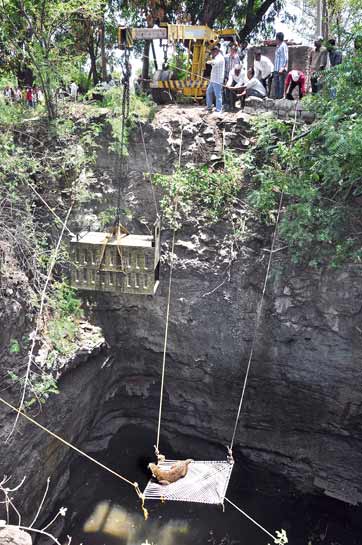
RESCUING A SPOTTED CAT Text and photographs by Mandar Sable In the dark of the night on July 1, 2014, in Kolhar village in Ahmednagar's Rahata taluka, a handsome two-and-half to three-year-old male leopard patiently watched his quarry - probably a wild pig or an errant dog. As he charged toward his prey, he hardly expected instead to plummet some 20 m. down a gaping six-metre-wide unfenced well. For most animals that fall into such wells, their story is well and truly over. It was different for this leopard and that leaves me with hope for humanity. It began with the farmer who owned the well who, instead of panicking, immediately contacted the Forest Department. When the officials arrived they decided to try an innovative idea. They lowered a charpoy (rustic bed) with ropes safely secured to its four sides for stability. The desperate, and probably on-its-last-legs leopard, quickly clambered on to the cot. When this makeshift platform was raised midway up the deep well, a crane was used to lower a cage into the well, at precisely the same level as the cot. The leopard entered the cage. The door was very carefully shut. The leopard was confined, treated, then released into the nearest forest by the officials. This story ended well, but that is the exception, not the rule. Repeated incidents of leopards, lions and other large and small animals dying after falling into open wells is a serious wildlife conservation issue that needs urgent policy attention from the district, not merely wildlife authorities. The Ahmednagar district is rich in biodiversity with the greatest movement of leopards seen in Akola, Sangamner, Rahata, Parner, Ahmednagar and the Sevagava talukas. Not surprisingly, leopard-human conflict and dog and other livestock kills are high. 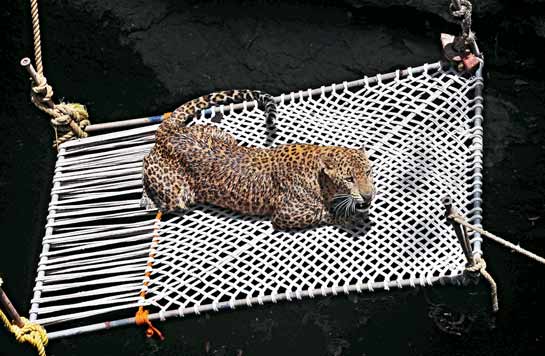
Sugarcane farming is the main source of livelihood in Ahmednagar district and most wells near the farms lack confining walls. Incidents of leopards falling into the well at night while chasing prey are frequent. Often the animal is seriously wounded or succumbs to injuries sustained during the fall, or the rescue. In most cases, there is no suitable ledge or crevice inside the well and the animal drowns after hours of desperate swimming to stay alive. Some wells have narrow mouths, making it extremely difficult to get the animal out. And what should we say about the crowd that gathers around to see the fallen leopard? Its entertainment for them and poses serious danger to rescuers and to the public too, not to mention the hapless animal itself. The overburdened Forest Department officials themselves are in need of specialised training. Lowering heavy metal cages using cranes definitely helps minimise injuries to the unfortunate animal, but this efficient and less risky method is also more expensive. And wildlife issues, as we know, are accorded a low priority in India. Human-animal conflicts are going to escalate as we eat into more and more forested habitats. With little or no healthy, viable, prey available to them, the big cats will venture out to seek food. It is not just the wells - leopards are often caught and killed in traps laid by local poachers. Some fall victim to speeding trains, others are run over by fast-moving vehicles and some are beaten to pulp by mobs armed with sticks, stones and even kerosene, used to burn leopards, wolves, bears or any other animal the mob stumbles upon. Mahatma Gandhi's words sound clichéd only because they ring true: “The greatness of a nation can be judged by the way it treats its animals." 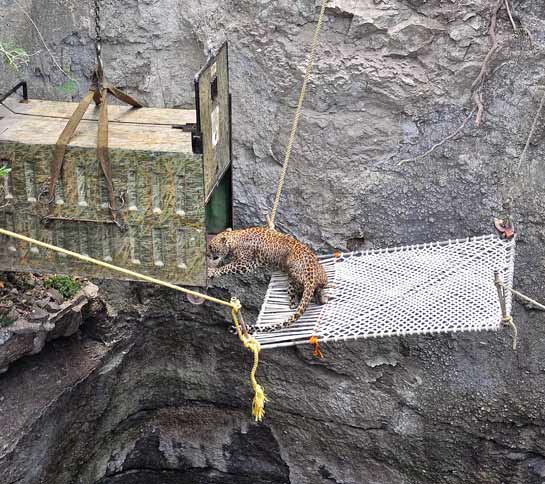
We should ponder this truth and collectively work toward plans to tackle key human-wildlife conflict issues in a cross-sectoral way. The problem of wildlife falling into open wells or canals has been successfully tackled by the simple device of building protective barriers around wells. But the larger issues of human-wildlife conflict need to be addressed by a nation that is fast becoming so self-absorbed, insensitive and dehumanised that it forgets how dependent its citizens ultimately are on nature for their own survival. |
First appeared in: Sanctuary Asia, Vol. XXXIV No. 4, August 2014.