London Conference On Illegal Wildlife Trade Issues Declaration, India Fails To Attend
Author:
First published in Sanctuary Asia,
Vol. 34
No. 2,
February 2014
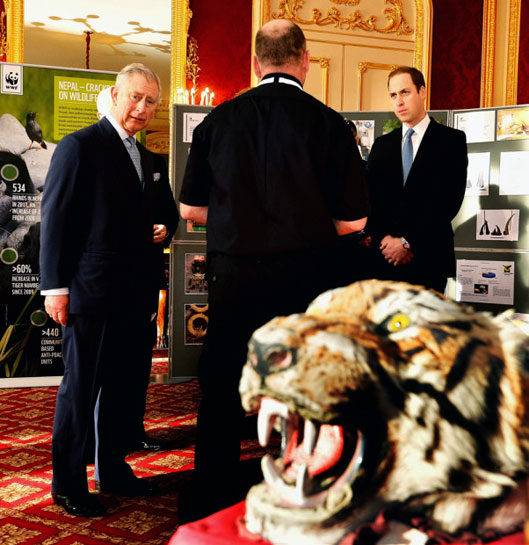
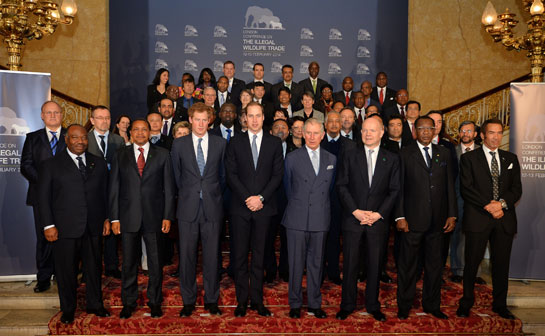 Photo credit: WPA (Getty).
The illegal trade in wildlife slaughters thousands of elephants, rhinos, tigers and other endangered species each year. India loses scores of one-horned rhinos, tigers, elephants and other species to poachers annually. New Delhi failed, however, to send a representative to the talks.
U.K. Foreign Secretary William Hague, a conference host, said he believed that the conference would be a turning point in the fight against the illegal trade, which is rated as the fourth most profitable global crime nexus. Hague said, “This is now a global criminal industry, ranked alongside drugs, arms, and human trafficking. It drives corruption and insecurity, and undermines efforts to cut poverty and promote sustainable development, particularly in African countries." The conference was attended by four African heads of state, members of the British royal family, representatives from 46 countries, and celebrities concerned about poaching. Action film star Jackie Chan attended, and declared that a generational shift is underway in China, with younger Chinese people opposing ivory consumption.
The conference issued a 13-page declaration that described the illegal wildlife trade as having “significant scale and detrimental economic, social and environmental consequences." The participating countries agreed to address corruption, adopt legislation for tougher penalties against poachers, and recruit more law enforcement officers. Secretary Hague applauded the decision that governments would not procure wildlife products officially. According to leading primatologist Jane Goodall, days after the conference, Prince William expressed support for his father's backing for the campaign against elephant poaching, telling her that he would “like to see all the ivory owned by Buckingham Palace destroyed." The royal collection contains some 1,200 artifacts dating back hundreds of years. The royal family are avid hunters of big game in Africa and Europe.
Photo credit: The British Monarchy.
A new study cited at the conference showed that five countries in central Africa lost 65% of their forest elephant population between 2002 and 2011 despite an ivory sales ban imposed in 1989. In 2013, South Africa alone lost more than 1,000 rhinos to poachers, up from just 13 in 2007.
Ali Bongo Ondima, the president of Gabon, was joined at the conference by three other African heads of state from Chad, Botswana, and Tanzania. President Ondima said that the illegal wildlife trade is a national security issue for his country. Uganda, Rwanda, Chad, Botswana, and Ethiopia launched an elephant protection initiative at the conference. Botswana will host a follow-up high-level meeting in 2015 to discuss progress on tackling the trade.
Conservation groups have welcome the London declaration, with the WWF describing it as strongly worded, and the Environmental Investigation Agency (EIA) saying it contained "meaningful actions."
Declaration of the London Conference on The Illegal Wildlife Trade, 12-13 February 2014:
London Wildlife Conference Declaration-140213.pdf.
Prime Minister Singh's Dismal Environmental Record:
F For Failed.
The Wildlife Crime Nexus: The Wildlife Crime Nexus.
Author: Jennifer Scarlott.