Maharashtra’s Mangroves Notified As Reserved Forests
Author:
First published in Sanctuary Asia,
Vol. 36
No. 8,
August 2016
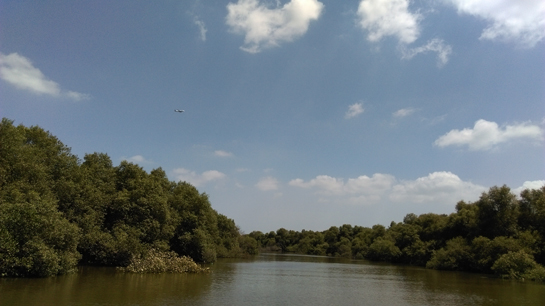 Photo: Gaurav Shirodkar.
Before this, mangroves were protected under the Environment Protection Act, and Coastal Regulation Zone (CRZ) notification and several other laws that prevent illicit tree felling in the regions. Under CRZ, apart from the Forest Department's special Mangrove Cell, the Urban Development, Revenue and Pollution Board were also stakeholders in decisions involving the mangroves. The newly passed Reserved Forest notification, the Forest Conservation Act, will add a layer of legal protection to these wetland ecosystems.
“By virtue of this notification, the Forest Conservation Act comes into play. This makes it a little more difficult for developers' and government projects to be sanctioned in mangrove areas," says D. Stalin of Vanashakti. “The flip side is that the figures include only government-owned lands. Huge areas of mangroves are privately owned. These areas will be covered under the tag of forests only after a process of consultation with the owners and compensation will need to be given to them."
The Coastal Regulation Zone (CRZ)-1 category offered the mangroves the highest order of protection without discriminating between government lands and private lands. Now that this blanket protection has been lifted and mangroves have been segregated on the basis of their ownership, they will be dictated by a different set of laws in terms of level of protection, and sanctions given to developers and government projects. This is a major setback. With this new status, mangroves will now be treated on par with terrestrial forests making them available for diversion to accommodate infrastructural projects. Under CRZ, this wouldn't have been possible.
“This is not a victory, it is a failure to implement the CRZ notification that offered blanket protection to coastal landscapes. Diversion of forest land proposals will be considered and this brings coastal forests on par with terrestrial forests. Wetland ecosystems cannot be replicated by compensatory afforestation and this crucial aspect has been lost on everyone," says Stalin.
“The Hon`ble High Court has begun to issue orders allowing the destruction of mangroves by compensating them with plantations in places like Dahanu. When you destroy mangroves, you don't cut trees, you destroy the wetlands ecosystem comprising of mud flats, inter tidal grass, and the habitat of resident / migratory wetland fauna. There is no clarity on whether the CRZ notification will prevail or the Forest Conservation Act will prevail."
A possible boon in this scenario is that the Forest Department will be in sole charge of the conservation of these mangroves, instead of the multiple boards and bodies that had bureaucratized but not enhanced mangrove protection.
N. Vasudevan, Chief Conservator of Forests, Mangrove Cell, adds “Maharashtra is the only state in the country to notify all mangroves on government land as Reserved Forests. This is a very important development worthy of emulation by all other coastal states. Reserved Forest status is undoubtedly the strongest tool in our hand to protect our mangroves, as there is a strong machinery on the ground for enforcement of the legal provisions. The Government of Maharashtra has taken many proactive steps for conservation of mangroves in the recent times, which includes the establishment of the Mangrove Cell under the Forest Department, setting up of the Mangrove Foundation with a corpus fund of 115.75 crores, and the promotion of mangrove-based livelihood programmes among coastal communities. It is no coincidence that the mangrove cover of Maharashtra registered a phenomenal increase of 20 per cent between 2013 and 2015, which is the highest in the country."

