Monsoon Is Here, So Are The Frogs
Author:
First published in Sanctuary Asia,
Vol. 34
No. 7,
July 2014
Frogs and toads are amphibians -this means they live a ‘dual life' - as larvae in water and as adults on land. They evolved from fish around 400 million years ago by developing limbs and lungs. Amphibians are classified into three major groups or orders - Anura, which includes frogs and toads, Urodela, which comprises salamanders and newts and Gymnophiona, which covers caecilians. Amphibians feed on land but return to the water to breed. The females lay eggs in and around water bodies and the tadpoles that hatch breathe through external gills. When they grow into adults, the external gills (in most species) vanish to be replaced by lungs.
Indian bull frog
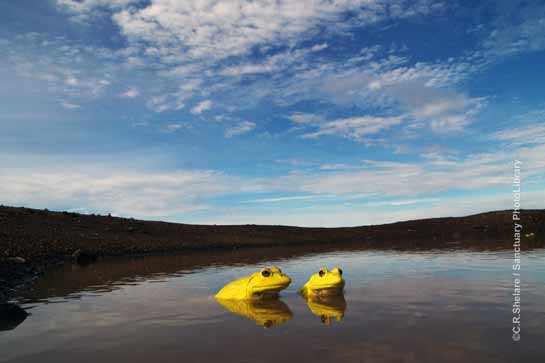 Photo: C.R. Shelare.
The Indian bull frog Hoplobatrachus tigerinusis the largest species of frog in India. Did you know the dull-olive-green coloured male will turn a bright yellow with blue vocal sacs in the breeding season? It is found in wetland areas but also faces a lot of danger from humans who hunt it for food and pollute its habitat.
Ornate Narrow-mouthed Frog
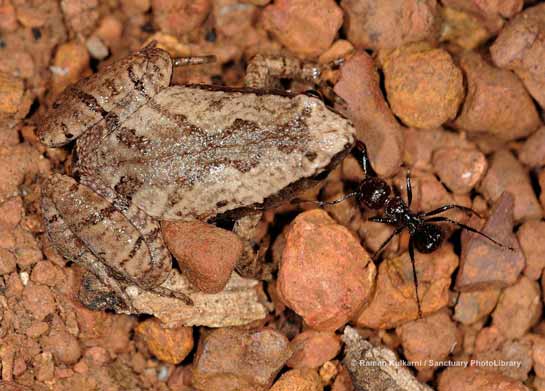 Photo: Yuwaraj Gurjar.
The ornate narrow-mouthed frog Microhyla ornata is found in the forests of South Asia. It can be easily identified by atypical arrow-shaped mark on its dorsal (upper) side. It is usually active at night, though during the monsoon, it can also be spotted in temporary rain pools and other water bodies during the day.
Bronze Frog
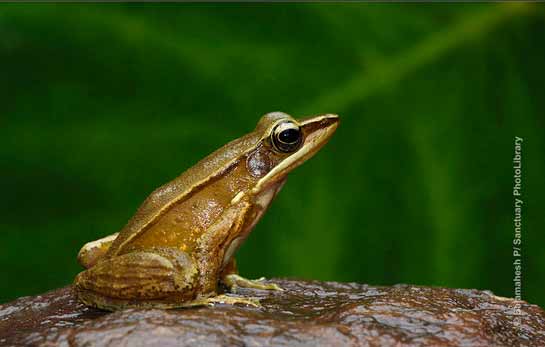 Photo: Balamahesh P.
The bronze frog Hylarana temporalis loves the wet, green, dense forests of the Western Ghats as well as the Sri Lankan highlands. It has a bronze coloured stripe running from its snout, along its lower jaw and the sides of its body to the lower limbs, which is how it gets its name. It is a favourite food of the Malabar pit viper.
Bi-coloured frog
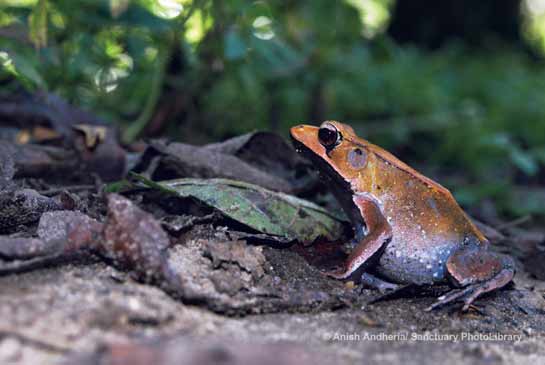 Photo: Anish Andheria.
The bi-coloured frog Clinotarsus curtipes is found in evergreen to semi-evergreen moist forests as well as dry deciduous forests in the Western Ghats. It breeds in both ponds and large lakes. It is a leaf-litter frog - which means on land, it is found on the forest floor. Interestingly, adults of this species may play dead to fool predators.
Wrinkled Frog
Photo: Raman Kulkarni.
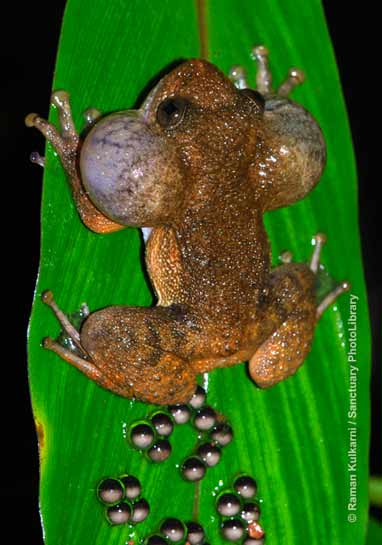
The wrinkled frog or Bombay night frog Nyctibatrachus humayuni is a frog found only in the moist forests of the Western Ghats in India. After mating, the wrinkled frog females will deposit the eggs and go away. The male will then fertilise the eggs and guard the territory to prevent predation. This is very unusual and not seen in most frog species. Its scientific name is derived from Humayun Abdulali of the Bombay Natural History Society who first discovered these frogs at Khandala, Maharashtra.
Tree Frog
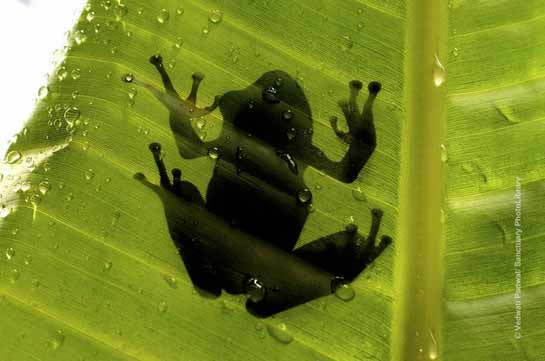 Photo: Vedwati Padwal.
The frogs of the genus Polypedates are commonly called tree frogs. They are semi-arboreal which means they also live on trees. They have a slender body with a pointed snout and bulgy eyes. At the end of each toe, they have a large disc, which allows them to climb well on all kind of surfaces. They occur in east, south and southeast Asia.
Beddome's Leaping Frog
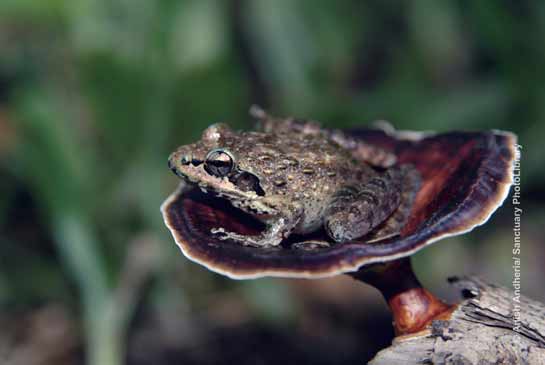 Photo: Anish Andheria.
The Beddome's leaping frog Indirana beddomii is found on the ground in the moist deciduous and evergreen forests of Western Ghats of southern India. It is named after the herpetologist/naturalist Richard Henry Beddome. If disturbed, it will quickly move away taking long leaps. Amphibians such as the leaping frog are known as ‘indicator species' - their absence or presence indicates the health of the ecosystem they live in.
Bompu Litter Frog
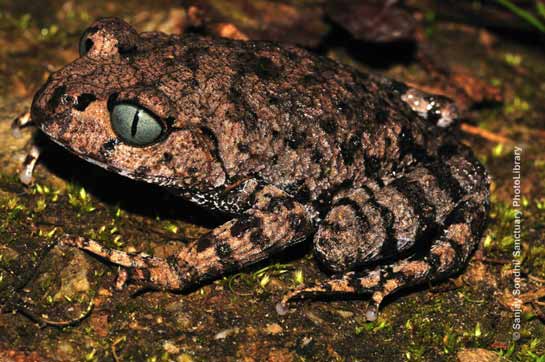 Photo: Sanjay Sondhi.
The Bompu litter frog Leptobrachium bompu, is also known as the blue eyed frog. It was first discovered in the dense evergreen forests of Bompu by Sanjay Sondhi and Ohler in the Eaglenest Wildlife Sanctuary in Arunachal Pradesh. It belongs to a family of what is known as ‘litter frogs', as they live amongst leaf litter.
Malabar Gliding Frog
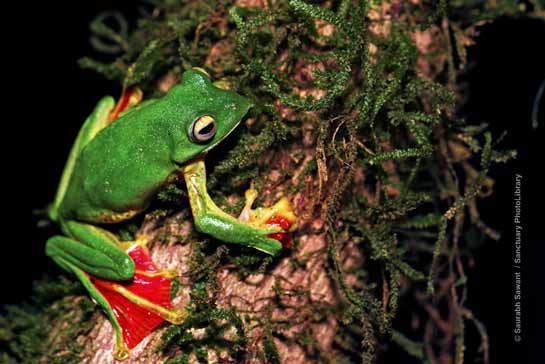 Photo: Saurabh Sawant.
The Malabar gliding frog or Malabar flying frog Rhacophorus malabaricus is found in the moss and fern forests of the Western Ghats. It can leap from tree to tree with the aid of the stretched webbing between the toes of its feet. It makes a frothy nest above the water in which the tadpoles develop and then drop in the water below to complete their metamorphosis. It is an opportunistic hunter which means it'll catch almost anything it can find. It is easy to identify thanks to its bright green colour.
Bombay Bush Frog
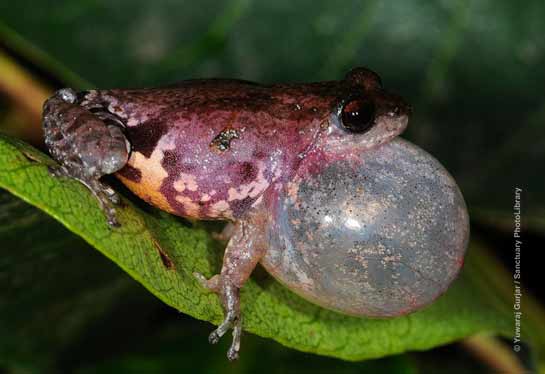 Photo: Yuwaraj Gurjar.
The Bombay bush frog Philautus bombayensis is a tiny frog recorded only in India. Its call sounds like a typewriter at work.
Read More:
Frog Walk With Dr. Sathyabhama Das Biju At The Sanjay Gandhi National Park In Mumbai.
Nationwide Amphibian Photography Contest Conceptualised by Lost Amphibians of India, Powered by Sanctuary Asia with Dr. Caesar Photography.
First appeared in: Sanctuary Cub, July 2013.