Mumbai-Based Scientist Duo Discover New Species Of Spider
Author:
First published in Sanctuary Asia,
Vol. 35
No. 9,
September 2015
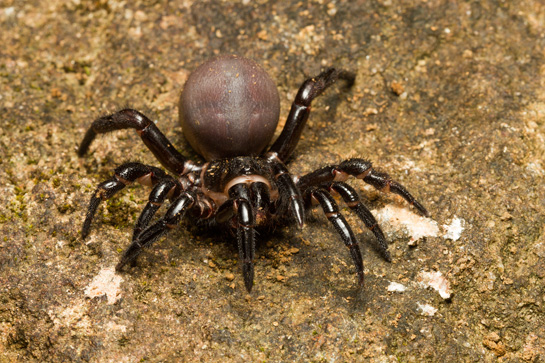 Photo: Zeeshan Mirza.
With an impressive 3.3 cm. body length, H. maximus outgrows the average trapdoor spiders which grow between one to two centimeters long. Zeeshan Mirza and Rajesh Sanap, a Mumbai-based scientist duo, found the spider in the Peppara Wildlife Sanctuary near Trivandrum while on a Rufford Small Grant and Department of Science and Technology funded survey of mygalomorph spiders of Kerala.
“Unlike most spiders, trapdoor spiders live in burrows in the ground which are covered by a well-camouflaged hinged door. Hence, such a large and distinct spider remained unnoticed for such a long time as it is almost impossible to spot it unless one is trained to spot burrows of these spiders." says Zeeshan. “Most unexpectedly, on our very first day in Peppara Wildlife Sanctuary, within 100 m. from our accommodation, we noticed the burrow of an unusual spider, and we knew this one was hitherto unknown to science. It digs very shallow burrows, only up to 15- 16 cm. deep which is unusual for a trapdoor spider this large," he added.
The Western Ghats are recognized as a biodiversity hotspot, and according to Mirza its invertebrate fauna is poorly documented. He says that it won't come as a surprise if several more trapdoor species are discovered here.
Zeeshan and Rajesh have as a team, till date, described 25 new species of geckos, spiders and scorpions including H. maximus. They have been the recipients of the prestigious Sanctuary Asia Wildlife Service Award in 2014 and Zeeshan had bagged the Sanctuary Young Naturalist Award in 2010.
The study has been published in the Journal of Asia-Pacific Biodoversity.
Read more: Earth Heroes - Zeeshan Mirza
                    Earth Heroes - Zeeshan Mirza and Rajesh Sanap

