Mumbai’s Forgotten Shores - The Coastal Road
Author:
First published in Sanctuary Asia,
Vol. 39
No. 6,
June 2019
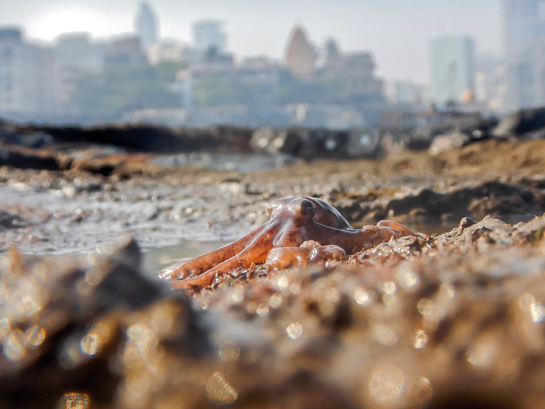 Photo: Anurag Karekar
Download the report:Â A Case Against The Mumbai Coastal Road ProjectÂ
You never forget a first.
Two years ago, I walked on a Mumbai shore for something other than exercise for the first time.
The message on my phone said, “Haji Ali shore walk. 6.30 a.m." Until then, the only thing that could nudge me out of bed that early was a forest safari with the promise of stripes. I casually reached the rocky patch of shore behind the Haji Ali durgah an hour late, expecting to be underwhelmed. How could this crowded, polluted coast possibly host wildlife? The three founders of Marine Life of Mumbai - Pradip Patade, Abhishek Jamalabad and Siddharth Chakravarty (see Sanctuary Vol. XXXVIII No. 10, October 2018) - seemed to be unduly excited about a few crabs.
But a closer look at the tiny tide pools that day - and almost every low tide cycle since - turned everything I thought I knew about my city's shore on its head. Our idea of a marine space is usually one filled with crashing waves and the swell of high tide, not a vast rocky outcrop that even the water seemed to abandon, receding far into the distance (just like the flawed notion that a forest equals dense trees, and seemingly ‘empty' grasslands that host many animals).
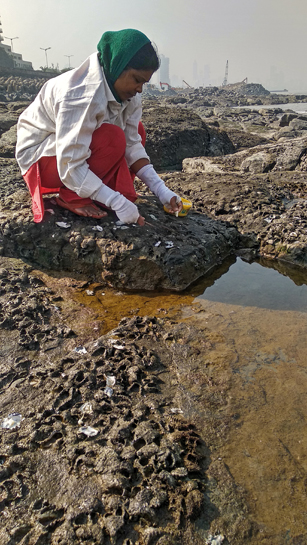
But here, the durgah stood guard over a small colony of rust-orange, hexagonal polyps of false pillow coral, resembling a honeybee comb draped on a rock. A short distance away, a sea fan (also a type of coral), sat partly submerged. People swarmed on the road outside, and on the walkway to the durgah. Sky scrapers rose impossibly close together around us. I looked down towards the resolute tide pools, where two Schedule 1 species thrived in the heart of the one of the busiest places in Mumbai.
Later, I needed no convincing when Abhishek Jamalabad asked me to help structure intertidal-specific content for Marine Life of Mumbai and build a team that could turn into an ever-growing community in Mumbai. I planned to leave in three months, but two years later, I am still here, learning a little more about the shore life every day.
I know now, that a fiddler crab uses its larger claw to attract its mate, and is delightfully called Shio Maneki in Japan: ‘the one that beckons the tide'. An Arabian cowry is one of the few intertidal mammas to stay with her babies until they hatch. A fresh, juicy patch of hydroids means that there are aeolid nudibranchs (sea slugs) around, while the innocuous-looking Conus is capable of ruining my day with its venomous harpoon. The unlikely sights in a city like Mumbai - sea anemones, wandering jellyfish, sea stars, carpets of neon-green zoanthids, brought me closer to the intertidal ecosystem with their superior abilities and glorious beauty.
| Coastal Commons to Coastal Roads: Loopholes and Legal Issues By Sarita Fernandes The Coastal Road Project has five pending petitions as of April 30, 2019, in the Mumbai High Court. The main reason for concern is the zero to low public consultation in the project and absence of scientific studies and impacts on the marine biodiversity in the proposed coastal zones of Mumbai. Unlike past public infrastructure projects, that had direct stakeholder consultation with the affected communities, with mitigated measures and solutions, this particular project has relied on the Environment Clearance (EC) from the Ministry of Environment, Forests and Climate Change (MoEFCC), without fulfilling the two major natural stakeholder requirements in case of the coast and the coastal road. The two main natural stakeholders being 1) The intertidal marine biodiversity and 2) The traditional - artisanal coastal communities in the proposed coastal road areas. Approaching common urban people who access these spaces on the promenade or otherwise is a whole other issue that the project has not even considered as stakeholders to be consulted. The Coastal Road Project will reclaim land from the sea to build an eight-lane highway that will connect South Mumbai to the suburbs (LiveMint 2019). The focus on connecting the city has been viewed with a singular centred - grand vision of it being the saviour of traffic snarls and its related issues that will decongest Mumbai's roads. However, this approach as observed in the development phases of the Coastal Road Project, has not completely understood the policy and legal protections that the city's coast is safeguarded under, to protect sensitive intertidal marine ecologies and the marine biodiversity of the city and native-traditional fishing communities dependent on it. According to the current coastal policy that governs India's coastline, the Coastal Regulation Zone notification (CRZ) 2011, the notification states CRZ-I A and B as ‘Classification of the CRZ for the purpose of conserving and protecting the coastal areas and marine waters, the CRZ areas shall be classified as follows, namely:- (i) CRZ-I A (The areas that are ecologically sensitive with geomorphological features which play a role in maintaining the integrity of the coast) and B (The areas between the Low tide line and High tide line).' The reclamation of the coastal road proposed and ongoing is within CRZ-I A and B areas. |
A Community Comes Together
But just when a community of marine enthusiasts is growing into an extraordinary movement set on the road to citizen-led research, the shore is changing forever. The Coastal Road Project is no longer an animated, illustrative map on our computer screens, but a reality that has begun in the form of soil testing structures, reclamation of coastlines and the razing of large chunks of the intertidal zone. The same intertidal that is protected under the Coastal Regulatory Zone (CRZ) notification. According to this document, the intertidal zone comes under section CRZ-I B where certain “reclamation activities are allowed, including foreshore facilities like ports, harbours, jetties, wharves, quays, slipway, bridges and sea links, etc." However, CRZ-I A protects unconditionally, certain animals in “ecologically sensitive areas and the geo-morphological features which play a role in maintaining the integrity of the coast." These include corals, found across Mumbai's coasts.
This is the equivalent of a forest being razed down. Over the last two years, the Marine Life of Mumbai project on the iNaturalist database holds over 2,000 observations (from 337 species), verified by global experts. Imagine what more lives in the parts that isn't yet in the public record.
So, while we use the protection that a few creatures enjoy from the Wildlife (Protection) Act, 1972, the entire coastline is under threat and will be impacted either directly or indirectly. And in that, the city itself.
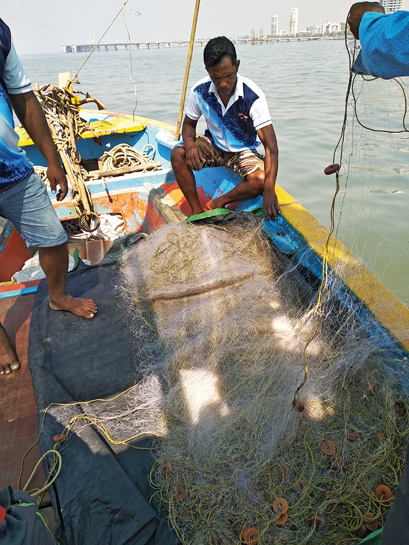
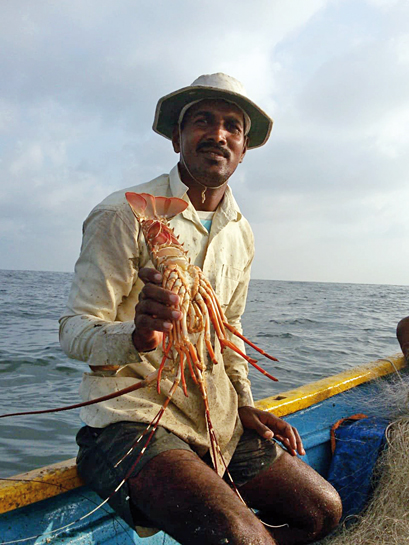
| The Contested Coast: Impacts of Reclamation on Artisanal Fishing in Mumbai By Shweta Wagh Photo: Shweta WaghIn November 2018, the Municipal Corporation of Mumbai (BMC) began dumping tons of debris in the intertidal areas of the city's western coast, to build a freeway. The project has been challenged in the High Court of Mumbai, on grounds that the ongoing reclamation works will also irreversibly alter the coastal morphology, the dependent biodiversity and traditional ecological practices of the artisanal fishing communities. The critics also pointed out that the freeway and the ongoing reclamation work is in breach of the law on environment clearances, traditional rights and jurisdiction. Photo: Nitesh PatilAs a coastal community that inhabits and practices its occupation in proximity to some of the most expensive real estate in the world, the artisanal fishers of Mumbai are vulnerable to development pressures. The coast and shallow seas are a productive landscape for fishers - their intricate fabric of economic, social and cultural life being rooted in the interface between land and water. Marine life thrives in shallow seas including inter-tidal and sub-tidal areas, which are important habitats. They are also feeding and spawning grounds for fish and a crucial part of the marine food chain. The health of the ecology and biodiversity of these shallow coastal waters are thus critical to the livelihoods of artisanal fishers. In contrast to the deep-sea fishers who employ large boats, and whose expeditions often last over days, artisan fishers engage in near-shore fishing using indigenous technologies and small or mid-sized boats, work individually or in smaller teams, and their expeditions synchronise with the daily tidal rhythms of the sea. Having adopted methods of fishing suited to the shallow coastal waters which provide a rich habitat for marine fauna, artisan fishing is a labour intensive, low-intensity, passive process, involving waiting for and trapping fish that move with currents or towards shallow waters or inter-tidal areas according to tidal, ecological or seasonal variations. Different kinds of specialised techniques have been evolved over time to harness these copious waters and involve the use of various kinds of tools, nets and gear, each adapted to varying depths of water, specific conditions of the coast and designed to catch different kinds of fish. The artisanal fishers have a long history of working with nature, and their knowledge of the sea and its resources have been acquired through practice, and passed on from generation to generation. The social impact assessment undertaken by the project proponents did not consult the fishing community, nor did it acknowledge the existence of fishing practices in the shallow waters of the Island City. However, a study by the Collective for Spatial Alternatives (CSA) documented intertidal and shallow water fishing practices, and a survey report by the Central Marine Fisheries Research Institute (CMFRI) showed the existence of Oyster beds provide livelihoods to local hand-pickers, particularly fisherwomen. The CMFRI report also acknowledged the presence of juveniles of some commercially important species of fish in near-shore areas, claiming that these acted as a nursery for juveniles. When challenged with these facts, the BMC insisted that the fisher-folk could be compensated or should transition to deep sea fishing. Photo: Shweta WaghTheirs is a way of life that is synchronous with tidal rhythms and sensitive to seasonal variations. They practice self-imposed customary prohibitions to fishing activity in certain seasons; as they fish close to the shoreline, and rarely move beyond it, they are also responsible and concerned about maintaining the health of coastal ecosystems. They thus feel that it would be both unviable and unsustainable for them to transition to deep sea fishing. The Coastal Road Project, which necessitates reclamation and intensive construction activity in the foreshore and near-shore areas will irreversibly damage the coastal ecosystem, and thereby dispossess the artisan fishing community of their traditional occupations, depriving them of their cultural rights. |
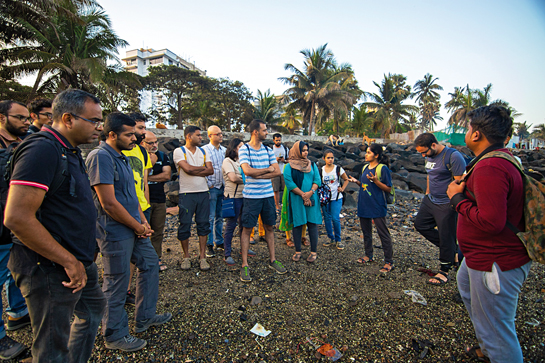 Photo: Shaunak Modi
Climate Change at Our Shores
Nikhil Anand, an author and scholar of infrastructure, urbanism and environment, writes in The Wire about the city's precarious history with its waterways.
To quote an excerpt from the piece: “Writing after Hurricane Katrina, which destroyed over 70 per cent of the city of New Orleans in 2005, Neil Smith insisted that ‘there is no such thing as a natural disaster'. Disasters, he argued, were the results not just of wind and rains, but the ways in which these interact with urban policy, infrastructure and social vulnerability. A TERI Environmental Status Report, commissioned by the MMRDA in 2015, finds that water logging in the region ‘is essentially a compounded impact of heavy rainfall and high tides together'. The 2006 Flood Fact Finding report of the Maharashtra State Government, pointed out floods ensue when ‘moderate intensity rainfall takes place close to the high tide period'. Finally, the Environmental Impact Assessment of the Coastal Road Project itself stated, ‘The problem of flooding is acute when heavy rainfall coincides with high tide', which according to the report is approximately 20 times every monsoon. ‘If the rain intensity is more than 25 mm. per hour and high tide occurs, there is always a possibility of flooding' (Coastal Road Drainage Report)."
These refer only to the current flooding problems, not accounting for climate change, or the rise in the yearly rainfall in the city.
| Marine - Intertidal Biodiversity: Legal Aspects The Coastal Road is proposed within CRZ-I A and B zones that provides policy protection of sensitive marine biodiversity like corals and coral reefs, mangrove habitats, nesting bird sites within these coastal zones, especially the intertidal areas. The intertidal areas under coastal policy of the Coastal Regulation Zone Notifications (CRZ) 2011, are coastal areas demarcated between the High Tide Line and Low Tide Line. Most CRZ-I A species are protected under the notification are found only in the CRZ-I B areas, the area between the High Tide Line and Low Tide Line. The Coastal Road Project that reclaims the intertidal zones of Mumbai's coast therefore violates the coastal policy provisions and contradicts the rationale of the need to protect intertidal coastal zones of the city and India's coastline as a whole. Based on the Public Interest Litigation filed by Vanashakti in April 2019, the legal loopholes identified on which the petition aims for legal protection of the marine-intertidal biodiversity: 1) There is no specific study on the number of species found in the intertidal zones of Mumbai. However, a collective ‘Marine Life of Mumbai' has documented independent expert sightings of around 320 marine species found in intertidal zones on iNaturalist. Another independent study by Sagarshakti (Marine and Coastal research division of Vanashakti) found 36 marine species on a four hour - two day shore-walk survey at Worli's intertidal rocky shores. No public funded body has undertaken any study on the total number of species and their habitat existing on the city's shores. 2) No baseline data is available even on the IUCN list for such marine-intertidal species, which have been found abundantly on Mumbai's shores. Reclamation poses an extinction risk to all these species in Mumbai's coastal intertidal shores. 3) The petition in its legal demands requests the scientific study and impact assessments, specific to these species found in the proposed intertidal areas to be reclaimed for the coastal road, to be conducted before the project reclaims and irreversibly destroys these sensitive coastal habitats. 4) Corals and Gorgonians, which are found on Mumbai's rocky shores are under Schedule I of the Wildlife (Protection) Act, 1972.. 5) Sponges and molluscs, which are found in Mumbai's intertidal shores are also mentioned in the Wildlife (Protection) Act, 1972 among other schedule species. |
In the face of these challenges, what good can something as simple as shore walks do? They can strengthen our weakened connection with the ocean, and the coastal identity of the city we inhabit. Two years on, I am now a familiar of that space, no longer uncertain of in finding my footing among the sharp-as-knives open oyster shells and barnacles.
I take my lessons from the way the tide behaves, how it flows around obstacles when it should, how it retreats when it must. I know instinctively what lives where, who feeds on whom and how to keep my distance, and yet have an enthusiastic one-sided conversation with these fellow citizens. It has aroused empathy - which I see reflected in every new person who joins the walks - towards the shore life that no amount of reading could have done.
As we go to press, the future is uncertain. Supreme Court has allowed existing work to continue but stopped all new reclamation for now. The BMC is to appoint the Central Marine Fisheries Research Institute to conduct a study on the project's impact on fishing, and suggest mitigation measures. Independent activists continue to protest, and historians are marking the origins of the coastal road plan, first proposed in 1870, and following the changes the city has made in the time.
Nature will find a way, and adapt to this ever-changing city, but what form it will take and in how much time is unknown. The ocean and its coast is all-powerful and will endure. Nature does not need us to protect it; it will outlive us and then some, It's us that we're fighting for, really.
Mumbai's intertidal zone is as busy as the rest of this tired city, its inhabitants living eventful lives, with a struggle not unlike our own. And that sort of kinship, armed with information, might affect change. Or it can try to pick up the pieces after devastation strikes. Time will tell.
Author: Sejal Mehta, First published in Sanctuary Asia, Vol XXXXI Issue 6, June 2019