New Frog Species Discovered In Goa
Author:
First published in Sanctuary Asia,
Vol. 35
No. 8,
August 2015
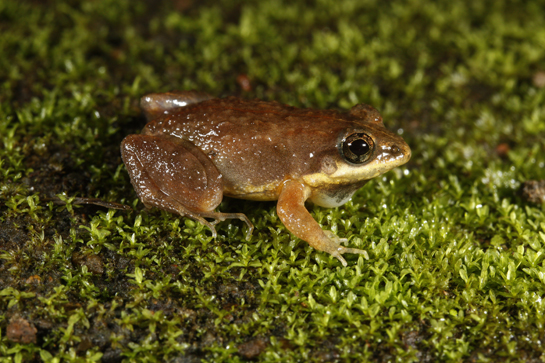 Photo: Nirmal Kulkarni.
During the late evenings in the lowland areas of the Western Ghats, parts of Goa and the hilly tracts of Belgaum, it is relatively common to hear a tinkling 'trick, trick' chorus call from local water bodies in the monsoons. Many of these songsters are terrestrial frogs, sitting besides mud pools and paddy fields, calling for mates. Although most of these frogs are land-based, they need water bodies to breed in. These terrestrial frogs belong to the amphibian genus Fejervarya of the family Dicroglossidae, and are commonly known as either 'cricket frogs' or 'fejervaryan frogs'. Ranging from small 19 mm. to large 56 mm. sizes, they are distributed throughout Asia. Most fejervaryan frogs are morphologically very similar and difficult to identify on the basis of external characters alone, creating taxonomic uncertainty in terms of names, identification and systematics.
A team led by K.P. Dinesh, S.P. Vijayakumar, Varun Torsekar and Kartik Shanker of Centre for Ecological Sciences, Indian Institute of Science, Bangalore, B.H. Chennakeshavamurthy of Zoological Survey of India, Calicut, and Nirmal Kulkarni of Mhadei Research Centre, Goa have published their findings on a new species of tiny fejervaryan frogs in the recent edition of the international taxonomic journal Zootaxa. The new species is called Fejervarya gomantaki, named after the state of Goa, where this species is found. Most fejervaryan species in South and South-east Asia are cryptic and difficult to identify on the basis of morphology alone. The authors have used a combination of morphologic, geographic and molecular methods to define the new species. In addition, the authors provide an overview of the systematics of the group and recommend supplementary sampling across the Asian continent. Presently, the new species is found in low lying, water logged areas of Goa and the adjoining hill ranges of Belgaum but a more detailed study is necessary to map its distribution range and understand its biology.
First published in: Sanctuary Asia.

