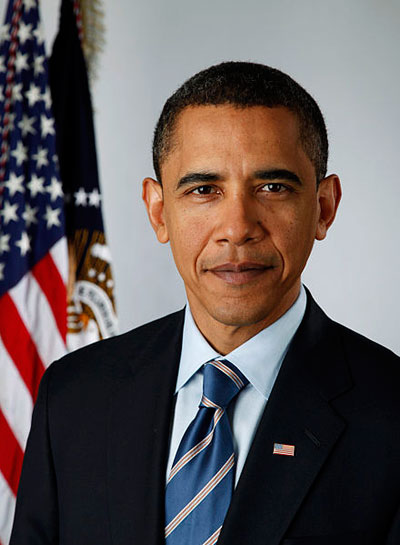
New Rhetoric From President Obama On Climate Change
Author:
First published in Sanctuary Asia,
Vol. 33
No. 7,
July 2013
Courtesy: Wikipedia.
He also renewed a pledge to cut U.S. carbon emissions by about 17 per cent by 2020, compared to 2005 levels.
“This is the holy grail," said Melinda Pierce of Sierra Club, an American environmental advocacy group. “That is the single biggest step he can take to help tackle carbon pollution." Other environmental organizations lauded the president's rhetoric, but cautioned that it could take more than a decade for the plans he laid out to be implemented. While the president laid out a broad vision for tackling climate change in his speech, he stopped short of describing specific emission targets, or details about how they will be implemented.
The administration had already proposed controls on new coal-fired plants, though those controls have not yet been finalized. President Obama's Tuesday announcement marked the first time that he confirmed plans to extend carbon controls not just to new plants, but to plants that are currently pumping greenhouse gases into the atmosphere as well.
Forty per cent of U.S. CO2 emissions, and one-third of greenhouse gases overall, come from electric power plants, according to the U.S. Department of Energy.
In his second inaugural address in January, and again in last week's speech, the president signaled that he will no longer wait for Congress to act on climate change, but will pursue administrative action not requiring legislative approval. Speaker of the House of Representatives John Boehner said that the Obama plan to put controls on existing power plants was “absolutely crazy." “Why would you want to increase the cost of energy and kill more American jobs?" Mr. Boehner asked, echoing the contentions of industry groups and many of his colleagues in the Republican-controlled House.
The president said he would expand production of renewable energy on public lands, and expressed repeated support for hydraulic fracturing, commonly known as “fracking," a process widely used throughout the U.S. for the extraction of natural gas. Many environmentalists strongly oppose fracking, saying that it represents an ongoing commitment to fossil fuel use, releases significant amounts of methane, a heat-trapping gas, and contaminates groundwater.
In Tuesday's speech, made at Georgetown University in Washington, D.C., President Obama made an unexpected reference to the controversial Keystone XL pipeline, which would carry oil extracted from tar sands in western Canada to refineries along the Texas Gulf Coast. He said that the pipeline should not be built if it would contribute to global warming. The U.S. State Department is due to make a final decision on the fate of the pipeline in a few months.
Despite the president's decision to take executive action in order to avoid protracted struggles with Congress, his rhetoric does not represent a short-cut to climate action in the United States. It will up to a decade, and the successful surmounting of many political and legal hurdles at the federal and state levels, before the president's plans can be implemented.
Author: Jennifer Scarlott, Source: The New York Times, Huffington Post.