No More 'Official' Big Cat Shootings
Author:
First published in Sanctuary Asia,
Vol. 33
No. 2,
February 2013
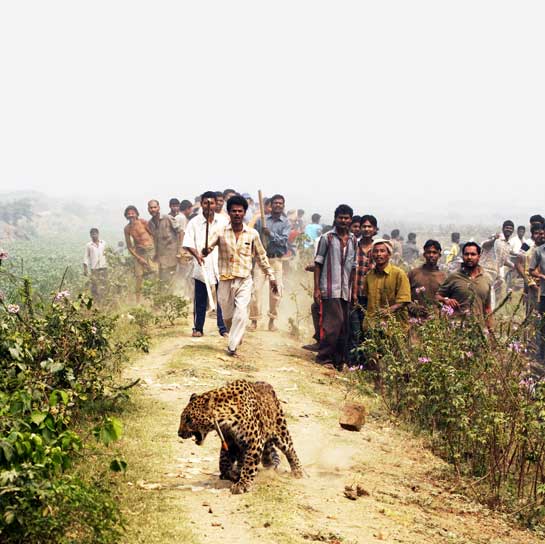 Photograph by Samsul Huda Patgiri.
This SOP will, for the first time, establish a uniform protocol for officials dealing with big cats that have strayed into human habitats. The 23-page ruling aims to provide the basic, minimum expectations of officers in the field in all India's tiger reserves, and states clearly that if a big cat strays into a human territory, a committee is to be constituted immediately for technical guidance and monitoring on day-to-day basis. This would comprise nominees of the State Chief Wildlife Warden and NTCA. It will also include a veterinarian, representatives from a local NGO and the local Panchayat besides the field director/or the concerned Forest Department officer.
The wildlife authorities have also stated that the age old Section 144 of the Criminal Procedure Code must be imposed by district authorities in areas holding a big cat, to ensure law and order, involving the local police and administration, as well as the Forest Department at an early stage, to make sure any agitated mobs are controlled. This is essential to avoid agitated local people surrounding the animal and hampering its capture operation, leading to serious injuries on people and staff. In several recent cases the interference by mobs worsened the situation and led to avoidable fatalities/ tragedies.
It was only last December last that forest officials in North Kerala were forced to kill a male tiger that had strayed out of Wayanad Wildlife Sanctuary. Residents joined by local political leaders had mounted pressure for either capturing or killing the wild cat, as it had attacked their cattle (Sanctuary Vol. XXXIII, No. 1, January 2013). Sanctuary's Facebook viewers were equally shocked by the story of a leopard being burned to death by locals from Corbett Tiger Reserve (Read more at https://www.facebook.com/sanctuaryasiapage).
The SOP also addresses the issue of tranquillisation, saying that chemical immobolisation must only be used if trapping efforts fail, and even then, should be carried out by a team of experts, that must include a veterinarian. The SOP also specifies the circumstances in which the trapped tiger is to be released, after recovery. If the tranquillised tiger is found to be healthy in prime or young age without any incapacitation (loss of canine, injury, broken paw etc.), as confirmed / certified by the expert committee then it may be released after radio collaring in a suitable habitat with adequate prey base. This should be done in such a way that the wild carnivore is not released into either the territory of a male resident tiger, or in proximity to human settlements, after sending intimation to the National Tiger Conservation Authority.
The comprehensive SOP has been sent to wildlife authorities across the country on January 30, 2013, and it is our greatest hope that it will bring an end to these senseless killings of India's big cats.
Source: Sanctuary Asia.

