PATH - Spreading Awareness About Roads That Lead Nowhere
Author:
First published in Sanctuary Asia,
Vol. 36
No. 2,
February 2016
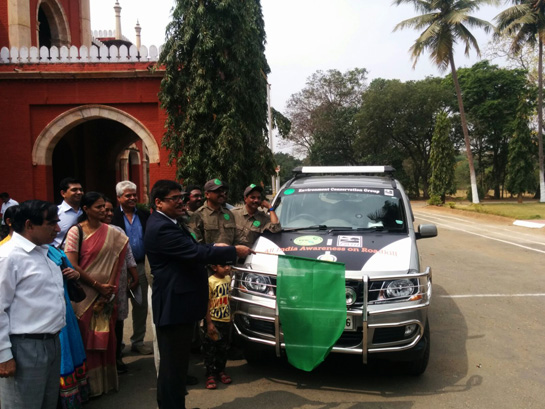 Photo Courtesy: Environment Conservation Group.
The team will travel through three biodiversity hotspots in the country - the Western Ghats, the Eastern Himalayan region and the Indo-Burma region - covering more than 20,000 km. across 22 states in six weeks as part of the programme titled PATH (Provide Animals safe Transit on Highways).
The PATH vehicle was flagged off on Monday, February 8 by Rajiv K. Srivastava, Additional Principal Chief Conservator of Forests and Director of Tamil Nadu Forest Academy. Journeying at a crucial time when the Government of India has fast-tracked all linear projects - roads, highways, transmission lines, pipe-lines, among others, the ECG members will document roadkills enroute, study mitigation measures undertaken by locals, place caution signage at important animal-crossing zones, spread awareness among college students and public, and publish a dossier. According to the Government's plans, an astounding 3.8 million dollars will be invested in the next few years to complete 1,00,000 kilometres of highway by 2017. It has relaxed a gamut of clearance requirements for linear projects whose definition is unclear and that pass through several states under the argument that they do not have much impact on the environment.
The reality however is starkly different. The number of wildlife roadkills on India's highways is only increasing with the sheer number of road construction and widening projects. Every year thousands of animals are killed on the road and focused studies are required to collect data on their numbers. Reckless driving is a major factor in animals being killed or maimed. Deaths of endangered species such as elephants, tigers and leopards on roads or railway tracks may appear in the news, but it is smaller animals such as monkeys, hares, snakes, turtles and frogs that bear a major brunt of human intrusion in their natural habitat. Multiple highway lanes and speeding traffic bisect wildlife corridors, affect their movement and undermine their long-term survival.
The chances of collisions between vehicles and animals will reduce to some extent if the government adopts a plan to build wildlife overpasses and underpasses at vulnerable crossing zones. But one must remember that animals do not follow traffic rules, and the best mitigation measures are the ones that keep our forests as clear of vehicles and intrusions as possible. ECG hopes to get this message across to the government and civil society as they drive across the country from Kanyakumari to Kashmir and Kutch to Meghalaya.

