Philippines Government Says Super Typhoon Haiyan Caused By Climate Change
Author:
First published in Sanctuary Asia,
Vol. 33
No. 11,
November 2013
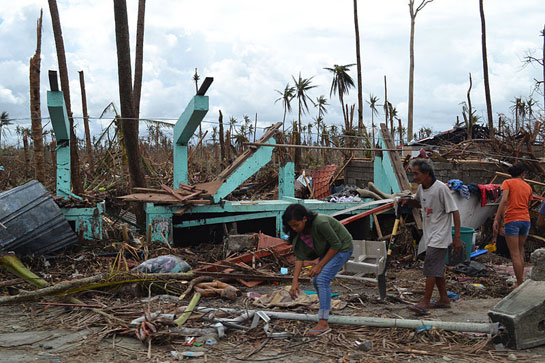
“We cannot sit and stay helpless staring at this international climate stalemate. It is now time to take action. We need an emergency climate pathway," said Yeb Sano, head of the Philippines delegation to the UN climate talks. “What my country is going through as a result of this extreme climate event is madness," Sano told delegates from 190 countries as the two-week climate negotiations got underway in Warsaw. “The climate crisis is madness. We can stop this madness. Right here in Warsaw. Typhoons such as Haiyan and its impacts represent a sobering reminder to the international community that we cannot afford to procrastinate on climate action."
Typhoon Haiyan hit the Philippines on Friday, November 8 with winds of 195 miles per hour and more. The category five storm sent waves as high as 5 metres and an enormous storm surge onto the central Philippines islands of Leyte and Samar, causing devastation that evoked images of Hiroshima and Nagasaki after their destruction by atomic bombs in 1945. At least 4,000 people were killed, and many times that number were injured and displaced. A humanitarian disaster of epic proportions left the government of the Philippines, and international aid efforts incapable of responding adequately. Even the roughly one million people who moved to shelters before the storm hit found themselves in harm's way. “There aren't too many buildings constructed that can withstand winds at 195 mph and more," said meteorology expert Jeff Masters.
Philippines chief delegate Sano made a similar plea to the delegates at last year's COP18 UN climate talks in Doha, Qatar, which also convened just as Typhoon Bopha destroyed much of the southern islands of the Philippines, killing around 1,110 people and causing more than $1 billion in damage. Declaring that he would fast for the entirety of the climate talks in Warsaw, Sano issued a challenge to those who doubt climate change has devastated his country: “To anyone who continues to deny the reality that is climate change, I dare them to go to the islands of the Pacific, the islands of the Caribbean and the islands of the Indian Ocean and see the impacts of rising sea levels." Sano went on to list climate-affected regions and communities around the world. He called on governments to commit to far more ambitious carbon emissions reductions than they have been willing to agree to so far.
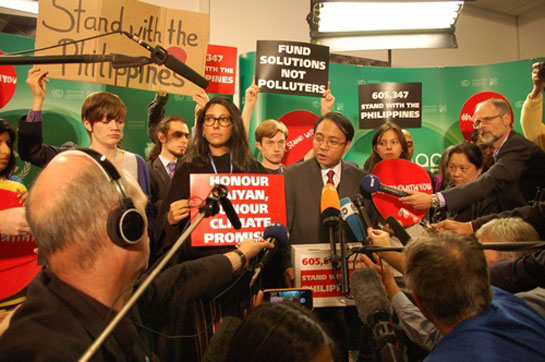
Youth climate campaigners have been very active at the Poland talks. They criticized Christiana Figueres, executive director of the UN framework convention on climate change (UNFCCC) for agreeing to give a speech at a coal conference that is simultaneously underway in Warsaw. Sierra Student Coalition delegate Ashok Chandwaney said, “The secretary's decision to engage with the coal industry ignores the reality that by attending their summit as a keynote speaker, she is legitimizing their presence and succumbing to their far-reaching influence on the UNFCCC process." Students and other climate campaigners have called the climate talks in Warsaw the “Coal COP," noting the irony of the Polish government's decision to host a World Coal Summit next door to the climate negotiations.
On Tuesday, November 19, one week into Mr. Sano's hunger strike, civil society groups and young people representing Avaaz, 350.org, and many other organizations joined Mr. Sano to deliver more than 600,000 signatures from people around the world who are standing with the Philippines to demand progress in Warsaw. Sano himself authored a petition on Avaaz calling for “major steps forward" in Warsaw on carbon pollution. His call was joined by similar petitions from 350.org, MoveOn, Friends of the Earth, CREDO Action, Forecast the Facts, SustainUS, 18 Million Rising, Greenpeace, and other organizations. Hoda Baraka, Global Communications Manager for 350.org, said, “The climate-related disaster in the Philippines is an urgent call to action which has been echoed around the world. We stand with the Philippines to honor the victims of this tragedy—and all those impacted by climate change—and shine a light on the real culprits: the fossil fuel industry."
For further information on climate change:
IPCC: Climate Change Is “Unequivocal", Urgent Action Is Critically Needed.
Author: Jennifer Scarlott, Source: The Guardian, 350.org.Â

