Rajasthan Opposes Lion Relocation Project
Author:
First published in Sanctuary Asia,
Vol. 35
No. 8,
August 2015
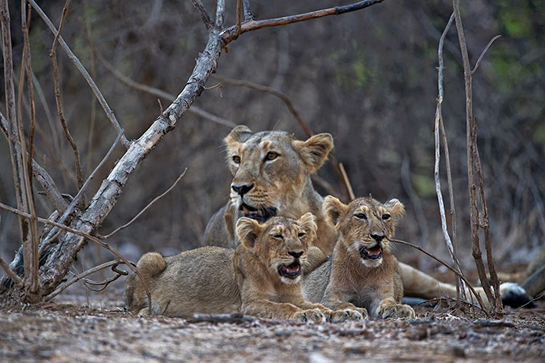 Photo: Shivaram Subramaniam.
The proposal to relocate a population of lions from Gir National Park in Gujarat to a protected area in Madhya Pradesh, has resulted in a controversy with the Rajasthan government. Contending that the relocation could lead to conflict with the apex predator in the area, the tiger, the Rajasthan government has objected to the scheme.
Although Prime Minister Narendra Modi had opposed the lion relocation project during his term as the Chief Minister of Gujarat, the Supreme Court had approved the relocation of lions from Gir to a habitat in Madhya Pradesh, where lions and tigers were said to have co-existed over a century ago.
Now, the Rajasthan government has strongly opposed the new proposition by questioning the possibility of coexistence in current times. The Rajasthan government strongly emphasized that the relocation of lions from Gir to Kuno Wildlife Sanctuary in Madhya Pradesh could endanger tigers from Ranthambore National Park, as tiger movement has been detected between both parks via a natural corridor.
Camera trap images have also established the presence of at least four of Ranthambore's tigers in and around Kuno in the last three years. A senior state government official reiterated the Rajasthan government's apprehensions, as he mentioned that “in such a scenario, there needs to be a study done on whether the two species of big cats can co-exist." He also voiced his concerns of either a lion or a tiger dying during a time of conflict between both predators.
The Rajasthan government's evidence of tiger movement in Kuno, was what prompted the environment ministry to make Rajasthan a part of the committee established to examine the relocation project.
The Gujarat government has further dented the proposed relocation project by deciding to explore the possibility of another lion habitat in the Amreli district of the Saurashtra region.
Source: Hindustan Times

