Rare Eurasian Otter Discovered In Central India
Author:
First published in Sanctuary Asia,
Vol. 36
No. 6,
June 2016
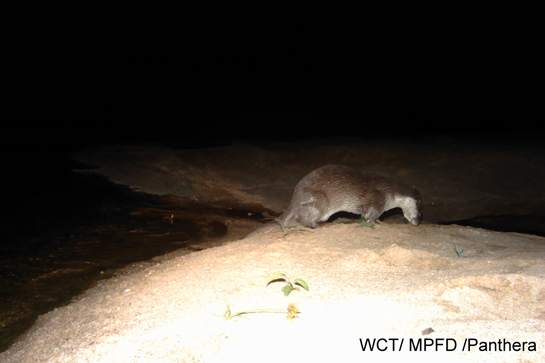 Photo: WCT/MPFD/Panthera.
Three species of otters are known to be present in India- the smooth-coated otter Lutrogale perspicillata, Asian small-clawed otter Aonyx cinerea and the Eurasian otter Lutra lutra. Out of these three, the smooth-coated otter is the most widely distributed in India, with several well-documented records. The Asian small-clawed is patchily distributed; found in the Himalayan foot hills in northern India, parts of the Eastern Ghats and in the southern Western Ghats.
Except for the smooth-coated otter, there is no evidence of the other two otter species from central India.
Based on indirect evidences and ancient records the Eurasian otter is believed to be found in the Himalayas and in some parts of the Western Ghats, however, there is no substantial evidence to confirm their presence since several decades. In other words, the presence of the Eurasian Otter in India is not yet known from any confirmed direct evidence till date. Additionally, based on all the published literature, the species has never been recorded from central India.
During this year's camera trapping exercise conducted by WCT and the MPFD, two species of otters, namely Smooth-coated otter and Eurasian otter were photo-captured at various locations within the Satpura Tiger Reserve and in the Kanha-Pench Corridor. All the sites in the Satpura Tiger Reserve were undisturbed areas due to the relocation of villages.
The Eurasian otter has a wide distribution covering Europe, Africa and Asia. The species is listed as Near Threatened as per the IUCN Red List (2004, 2008). Throughout its historic range, this species has either gone extinct from several regions or reduced to small isolated populations. Except for Europe, there is lack of data on population status and distribution of this species from the rest of the world.
These new photo-records of the Eurasian otter from the Satpura Tiger Reserve and Kanha-Pench Corridor not only extend their geographical range to central India but also provide the first ever photographic evidence of the species from India.
The field work by the Wildlife Conservation Trust in Madhya Pradesh was supported by the Madhya Pradesh Forest Department, the H.T. Parekh Foundation - a CSR initiative of the Housing Development Finance Corporation Limited (HDFC), USAID and Panthera.
India's flagship conservation programme Project Tiger has always aimed to preserve entire ecosystems and other forms of bio-diversity. Towards this endeavour of further improving the core areas, the Madhya Pradesh Forest Department has won multiple awards and recognition for the excellent implementation of the voluntary relocation of villages from STR under the leadership of the previous Field Director Shri R.P. Singh and the current Field Director Shri A.K. Nagar and Deputy Director A.K. Mishra. In recognition of the excellent work, the Prime Minister of India Shri Narendra Modi recently presented an award to STR.
The discovery of the Eurasian otter in the Satpura Tiger Reserve proves the value of large inviolate protected areas in conserving bio-diversity. The presence of the rare species in the Kanha-Pench corridor also proves the value of connected landscapes for highly endangered species such as gaur, wild dogs, leopards and now the Eurasian Otter.
In the reserve, apart from otters, several other species like the Indian Skimmer, Black-bellied Tern, Curlew Sandpiper, Marsh crocodile and a variety of fishes are dependent on these forest streams and rivers.
Issued by Madhya Pradesh Forest Department and Wildlife Conservation Trust (WCT)

