Round 2: Tiger Temple Takedown
Author:
First published in Sanctuary Asia,
Vol. 37
No. 4,
April 2017
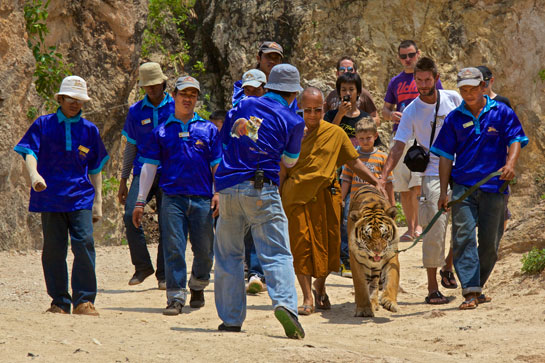 Photo: Steve Winter/National Geographic.
Less than a year ago, allegations of the abuse, neglect and illegal trade of tigers and other wildlife from Thailand's infamous Tiger Temple prompted a raid by government officials, who confiscated all of the monastery's 147 tigers. Inside the temple grounds, authorities discovered the frozen bodies of 40 tiger cubs, 20 tiger cubs preserved in jars, tiger pelts and other illegal wildlife products. There are currently seven cases under investigation involving illegal possession and trade of endangered species—but so far, none of these cases have landed in court. The rescued tigers now live in government wildlife centres.
Now, a Tiger Temple off-shoot business venture, a ‘tiger zoo', is under construction next door to the monastery, according to the National Geographic. In a widely-criticised move, Thailand's Department of National Parks, Wildlife and Plant Conservation (DNP) granted the Tiger Temple Co. Ltd. a permit for a ‘safari-style' tiger attraction in April 2016 that will allow visitors to interact with tigers, much like the Tiger Temple did. The new facility could be completed within months.
In December 2016, the company requested government approval to purchase 105 tigers from a failing ‘zoo' in central Thailand that breeds tigers but has never admitted tourists. Soon after, the entity changed its name to ‘Golden Tiger (Thailand) Co. Ltd.' in order to distance itself from the scandal surrounding the Tiger Temple. Conservationists and animal welfare activists fear that this new zoo will subject animals to inhumane treatment — and will ‘leak' tigers and other species into the transnational trade in endangered wildlife.
Most people don't understand the connection between these tiger attractions and the demise of tigers in the wild. Captive breeding drives a growing demand in China for tiger skins, bones, teeth and other products by supplying animals for the black market—a trade run by international, organised crime syndicates. Poaching to feed this trade has become the greatest threat to the survival of the world's last 3,800 wild tigers. More tigers were killed in India in 2016 than at any time in the last 15 years.
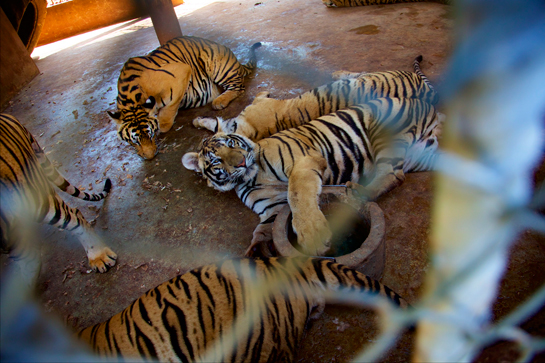 Photo: Steve Winter/National Geographic.
About 2,500 tigers exist within 30 sanctioned tiger breeding facilities across Thailand; many of them, like the Tiger Temple, present themselves as tiger tourism attractions. Another 6,000 cats live on ‘tiger farms' in China, and unknown numbers are being bred in Laos and Vietnam. These animals are usually crossbreeds, a mix of the six tiger subspecies, inbred and unhealthy and serve no conservation benefit. Breeding tigers for sale of their parts and products is prohibited under an international treaty signed by each of these countries, The Convention on International Trade in Endangered Species (CITES).
There is little hope that the government will shut down Thailand's lucrative wildlife tourism industry. The hope is to create awareness among potential visitors to avoid these wildlife attractions. But to stop the deadly trade in tiger products and save wild tigers, we must convince the government to outlaw captive breeding.
Last year, the Tiger Temple Takedown campaign saw support pour in from across the world, with hundreds of well-informed wildlife lovers successfully requesting Thai authorities to take action against the Tiger Temple. With the current plans for a new zoo, we're reviving the campaign. Please send an email to Thailand's Minister of Natural Resources and Environment requesting that:
1. The Golden Tiger (Thailand) Co. Ltd's zoo license be revoked.
2. All of those involved in illegal wildlife trade at the Tiger Temple be prosecuted and tried in a court of law.
3. That Thailand meet its CITES treaty commitment and outlaws captive breeding of tigers.
You can write to:
General Surasak Karnjanarat,
Minister of Natural Resources and Environment
92 Soi Phohol Yothin 7,
Phohol Yothin Road,
Sam San Nai, Phayathai
Bangkok 10400
Thailand
Email: attanop_1531@icloud.com
With a copy to: editorial@sanctuaryasia.com
2. Write to the National Office of Buddhism requesting that Phra Acham Phoosit (Chan) Kanthitharo, the Abbot of the Tiger Temple and any other monks related to illegal activity carried out at the temple be disrobed by the authority for violating Buddhist tenets of respect for all life.
You can write to:
Pongporn Parmsneh
Director General,
National Office of Buddhism
Salaya Sub-District, Phutthamonthon District,
Nakhonpathom Province 73170
Email: iconab@onab.go.th
With a copy to: editorial@sanctuaryasia.com

