Sanctuary Hosts A Flamingo And Wader Watch
Author:
First published in Sanctuary Asia,
Vol. 33
No. 4,
April 2013
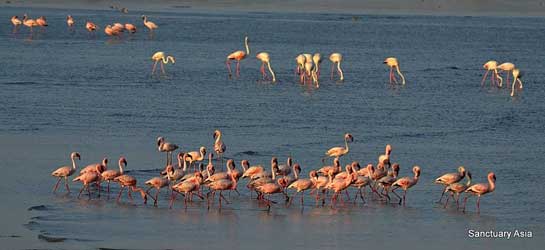
In a city that is increasingly losing its open spaces and where very few opportunities exist for families to spend purposeful, quality-time, together, outdoors, this outing offered one of the most breathtaking sights Mumbai has on offer… a virtual chiffon of pink flamingos, stretching all the way from Sewri to Chembur.
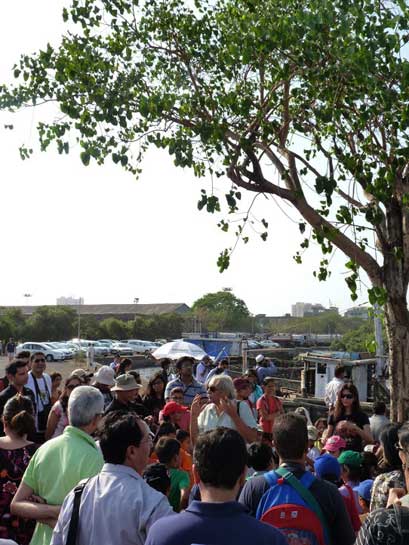
The visit was timed such that participants arrived right before low tide so that the flamingos (following the rising tide, which brought with it the food they love) would come closer and closer to the jetty, thus offering children and their parents some truly unforgettable sightings. On the day, we saw two species of flamingos - the Lesser (possibly 95 per cent of the total number of birds) and the Greater Flamingos, which Dr. ParvishPandya, the leader of the group explained, are larger and have pale pink bills, as against the dark crimson bills of their smaller cousins.
Four expert naturalists, which included Mayuresh Khatavkar, Abhijit Narvekar and Gaurav Shirodkar took charge of smaller groups, explaining how different birds (such as Black-tailed Godwit, Curlew Sandpiper, Western Reef Egret, Little Heron, Whiskered tern that were also seen) were equipped with different bill shapes and were therefore able to exploit diverse foods.
In response to questions the naturalists explained that the flamingos are thought to migrate to Mumbai from the Rann of Kutch in Gujarat, where they breed in large numbers, perhaps as many as half a million. Ornithologists believe that some of the birds could well arrive from Africa and West Asia.
About 10,000 - 15,000 of them visit Mumbai between the months of November and June and can be best seen in December - February. The Sewri mudflats are a perfect location for these beautiful birds to migrate to in order to avoid the unfavourable weather conditions in their breeding grounds every winter. This is because it provides the perfect habitat with the shallow, muddy, algae-filled waters. Since Sewri bay is surrounded by large factories, their effluents are released into the waters, and this creates perfect living conditions for blue-green algae, mollusks and brine shrimps which is the food the flamingos thrive on. The mangroves serve as a buffer from the city as well and protect the flamingos by keeping them relatively secure in their ecosystem.
However, over the years a lot of siltation has occurred in the area due to the destruction of mangroves, sewage disposal in the water, reclamation of land along the coast due to the construction of large complexes and more and more effluents and waste being released into the water which might foster the growth of algae for the flamingos but in the long run will slowly poison them. All these factors serve to slowly but surely destroy the flamingo's ecosystem. Sanctuary Asia strives to spread awareness about the link between biodiversity conservation through the protection of ecosystems and habitats.
Everyone who attended was thoroughly satisfied with their experience. Even the children that were present were clambering to get a good view of the birds through their binoculars or a chance at the spotting scopes. All the participants left with unforgettable memories of an evening well spent, observing the beauty of nature, and hoping to come back again soon!
Source: Sanctuary Asia.