Saxe's Elephant!
Author:
First published in Sanctuary Asia,
Vol. 33
No. 10,
October 2013
John Godfrey Saxe I was an American poet best known for his re-telling of the Indian parable The Blindmen and the Elephant, written over a century ago. Today, as the commodification of body parts of virtually every wild animal is rewriting Homo sapiens' relationship with nature, Sanctuary celebrates the sheer magic of the ‘sum of all parts' of the largest land mammal in the world.
The last stanza of this delightful poem speaks of theologic wars… but today the cap more perfectly fits the economists of the world who have demonstrated their knowledge of the price of every last resource on our planet, without comprehending the value of the sum of all its parts.
Photo: Swaroop Singha Roy.
A HINDOO FABLE
I.
It was six men of Indostan
To learning much inclined,
Who went to see the Elephant
(Though all of them were blind),
That each by observation
Might satisfy his mind.
II.
The First approached the Elephant,
And happening to fall
Against his broad and sturdy side,
At once began to bawl:
“God bless me! - but the Elephant
Is very like a wall!"
III.
The Second, feeling of the tusk,
Cried: “Ho! - what have we here
So very round and smooth and sharp?
To me ‘tis mighty clear
This wonder of an Elephant
Is very like a spear!"
IV.
The Third approached the animal,
And happening to take
The squirming trunk within his hands,
Thus boldly up and spake:
“I see," quoth he, “the Elephant
 Is very like a snake!"
V.
The Fourth reached out his eager hand,
 And felt about the knee.
“What most this wondrous beast is like
 Is mighty plain," quoth he;
“'Tis clear enough the Elephant
 Is very like a tree!"
VI.
The Fifth, who chanced to touch the ear,
Said: “E'en the blindest man
Can tell what this resembles most;
Deny the fact who can,
This marvel of an Elephant
Is very like a fan!"
VII.
The Sixth no sooner had begun
About the beast to grope,
Than, seizing on the swinging tail
That fell within his scope,
“I see," quoth he, “the Elephant
Is very like a rope!"
VIII.
And so these men of Indostan
Disputed loud and long,
Each in his own opinion
Exceeding stiff and strong,
Though each was partly in the right,
And all were in the wrong!
MORAL
So, oft in theologic wars
The disputants, I ween,
Rail on in utter ignorance
Of what each other mean,
And prate about an Elephant
Not one of them has seen!
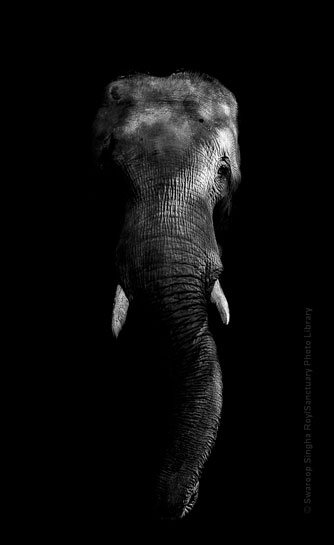
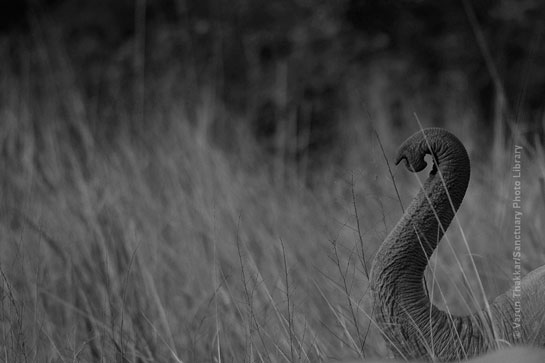 Photo: Varun Thakkar.
The trunk, or proboscis, is a fusion of the nose and upper lip. It is the longest nose in the animal kingdom with over 40,000 muscles that enables the elephant to feed, drink, defend itself and interact with family members. It is also used as a sensory organ.
 Photo: Monish M.
Given their high body-volume to skin-surface ratio, elephants must guard against heat loss, something their sparse hair helps them do. This works in exactly the opposite way than hair does for, say, the musk ox or polar bear.
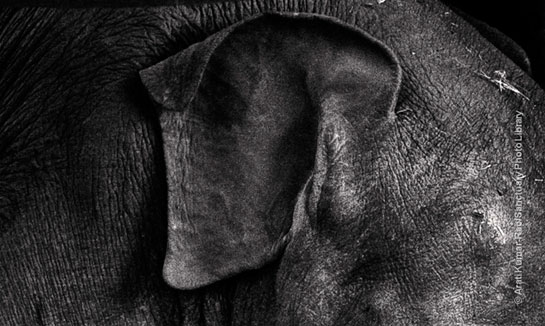 Photo: Arati Kumar Rao.
The African elephant's ear is three times the size of an Asian elephant's ear and they help regulate the huge animal's body temperature through an extensive network of capillaries. The ears can also pick up infrasound waves over remarkably long distances.
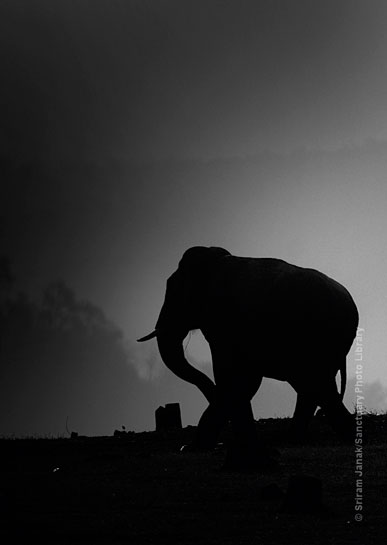
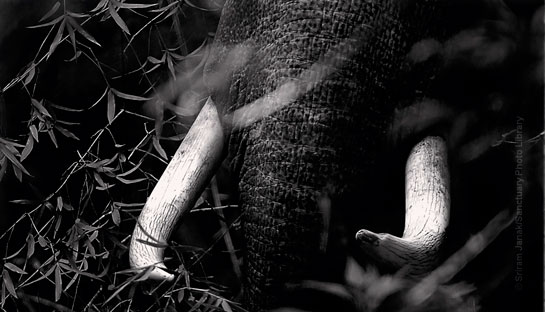 Photo: Sriram Janak.
The infamously-prized ivory tusks of elephants are merely the second upper incisors that grow throughout the life of Asian male elephants and African male and female pachyderms. Tusks of African elephants can grow to over three metres.
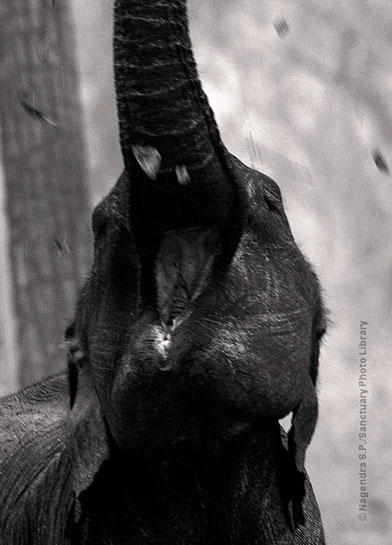
Photo: Nagendra S.P.
Elephants spend about 16 to 18 hours a day eating. The ancestors of today's elephants changed their feeding behaviour eight million years ago, from principally browsing for leaves to grazing on grass. This resulted in the adaptation of high-crowned teeth with molars that keep growing all through their lives. The lower lip of the Asian elephant is long and tapered, and short and round in African elephants.
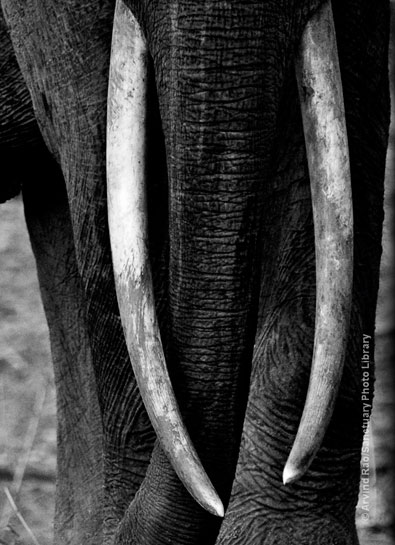
Photo: Arvind Rao.
Ivory poaching is driving rapid evolution in elephants with scientists suggesting that in the last 150 years, the world's elephant population has evolved much smaller tusks. The average size of both African and Asian elephant tusks has gone down by half. In fact, isolation of the subspecies Elephas maximus maximus in Sri Lanka has resulted in divergent evolution with most bulls being tuskless. It is believed that the killing of most bulls with large tusks for ivory has resulted in fewer large-tusked offspring.
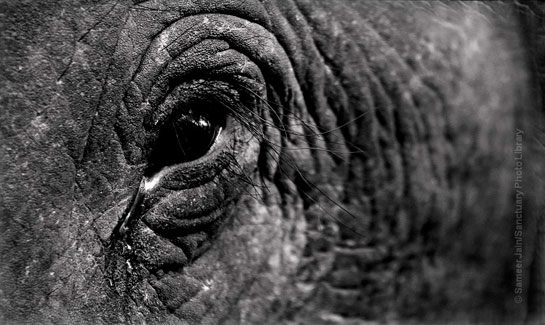 Photo: Sameer Jain.
Elephants have exceptionally small eyes and poor eyesight. Males have a temporal gland on each side of the head between the eye and the ear which produce a heavily-scented secretion. This is often seen trickling down the side of the face of males in heat.
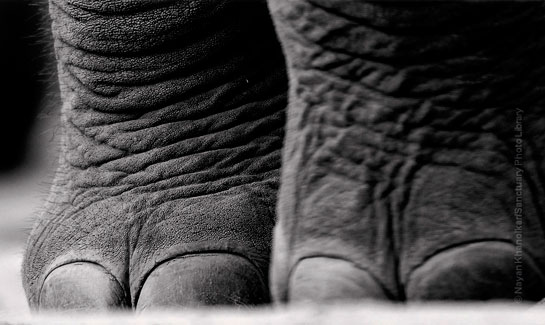 Photo: Nayan Khanolkar.
Elephants walk on their toes. The spongy, elastic cushion that encases their feet enables them to walk silently and helps them to dig up roots, create holes to collect water and move across harsh landscapes. An elephant's foot circumference suggests the size of the animal. The feet are also believed to help in detecting infrasound and vibrations transmitted underground.
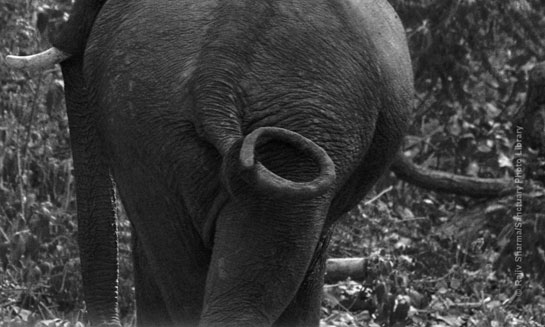 Photo: Rajiv Sharma.
For an animal whose body is virtually devoid of hair, the elephant's tail has remarkably long hair, sometimes reaching a length of as much as 100 cm. In almost continuous motion, the tail is used to dislodge flies and insects and also as a handle by elephant calves to hold on to when seeking security, or guidance from older animals when the herd is on the move.
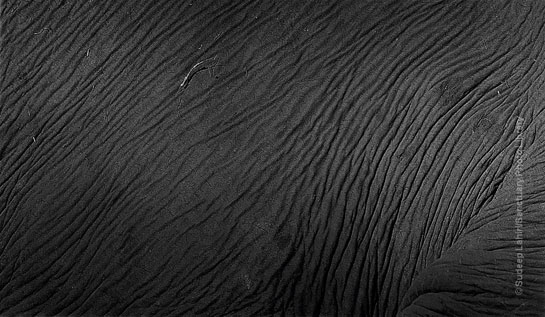 Photo: Sudeep Lahiri.
The dry but soft and supple skin, which lacks any sweat glands, is sensitive to UV radiation. This is the main reason that elephants wallow in mud and cover themselves in dirt. Though the natural colour of both African and Asian elephants is greyish black, their colour varies according to the colour of the area's soil that they throw on their backs.
Photo: Sriram Janak.
Though the elephant's brain is the largest of the land mammals, it occupies a small area at the back of the skull and the brain-to-body ratio is low. The temporal lobes give the elephant excellent senses of touch, smell, hearing and memory. Since large mammalian brains are associated with complex social structures and mental capabilities, it is not surprising that elephants are among the most social and intelligent species on our planet.
Sanctuary Asia, Vol. XXXIII No. 5, October 2013.