Success With A Pinch Of Salt - Bhitarkanika’s Saltwater Crocodiles
Author:
First published in Sanctuary Asia,
Vol. 32
No. 11,
November 2012
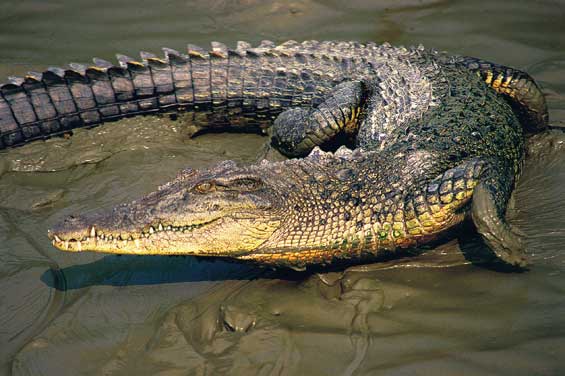
Photograph by Debal Sen.
The largest of all living crocodiles, the ‘salty' can measure seven metres in length! It is carnivorous and feeds primarily on fish, and occasionally on cattle, deer and wild pig. It also scavenges on carcasses. The mating season is usually between February and April and around May, females build mound-like nests, fashioned from twigs, leaves and mud, on high ground, in mangrove forests. Around 45 eggs are laid that will be fiercely guarded by the mother. The young ones hatch two-and-a-half months after the eggs are laid.
In the 1970s, when the croc population plummeted on account of poaching and over-exploitation, a project was undertaken in Bhitarkanika to collect eggs from nests, artificially incubate and then rear the hatchlings for release into creeks when they grew to roughly 1.2 m. Bhitarkanika's salties are now doing well, perhaps too well. The national park is now home to one of the most densely-packed saltwater crocodile populations in the world. According to Aditya Panda, a Sanctuary Young Naturalist Awardee, the reintroduction programme has perhaps turned out to be ‘too successful' for the relatively small area. The last census recorded around 1,700 crocs and some of the fearsome reptiles have been landing up in paddy fields, or swimming upstream to be bludgeoned to death by frightened villagers. And some humans have been attacked too!
But the reptiles are still endangered. And the primary threats come from illegal fishing and ports, particularly Dhamra, followed by relentless habitat degradation. A major long-term threat, of course, is climate change, which could possibly erase Bhitarkanika off the map as this coast is perceived to be the most vulnerable in the subcontinent.
The saltwater crocodile is listed in Schedule-I of the Wildlife (Protection) Act, 1972 and is marked ‘Endangered' in IUCN's Red Data Book. It also finds inclusion in Appendix-I of the Convention on International Trade in Endangered Species (CITES).
First appeared in: Sanctuary Asia, Vol XXXII No. 5, October 2012

