The Flying Lizard
Author:
First published in Sanctuary Asia,
Vol. 32
No. 11,
November 2012
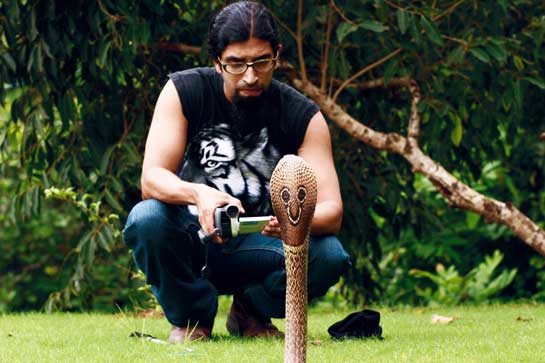
September 2012: Rahul Alvares, a wildlife consultant and snake rescuer based in Goa, is thrilled when he spots a flying lizard in the Cotiago Wildlife Sanctuary!
At around 10 o'clock one summer morning, I was sitting on a bench outside my room at the Cotigao Wildlife Sanctuary showing Deepak (a young forest worker) some of the pictures I had taken of wildlife around Goa. It was the fag end of a snake excursion I had organised for a client and Deepak and I were both yawning after staying out late in the forest the previous night.
Suddenly, Deepak cried out and reached across my shoulder to grab something off the tree trunk I was leaning against. The remaining yawns vanishing from my system, I swung around, half expecting to see something venomous and selfless Deepak taking the strike for me!
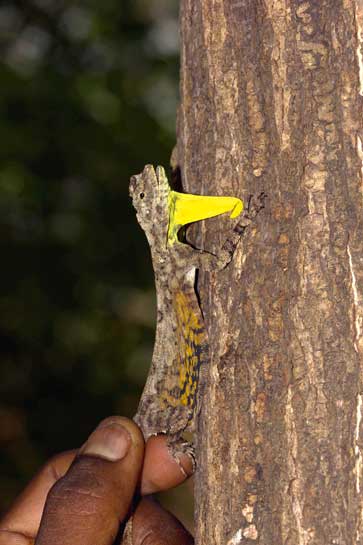
Of course, nothing as dramatic as that was happening. But what Deepak had reached for was no less interesting. He had managed to capture a Southern Flying Lizard Draco dussumieri! I was thrilled to bits! I have known about flying lizards in the Western Ghats for over a decade and yet never seen one in the wild.
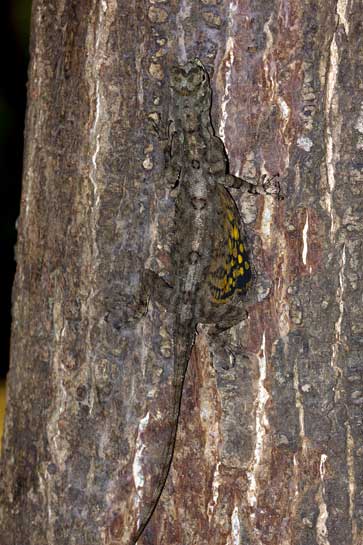
Photograph by Rahul Alvares.
It isn't as though they are extremely rare but they are very good at camouflage. Even with Deepak holding it by the tail, against the bark of the tree, and me standing a few feet away, I would keep losing it in my camera viewfinder. No wonder I hadn't found any until today! Did you know that this lizard, apparently feeds more or less exclusively on ants?
There are only two instances when the flying lizard gives itself away. The first is when it opens up its patagium (wing membrane) which is bright yellow in colour. The other is when the male erects a long lemon yellow appendage from below his throat to get the attention of the female.
Draco, as the flying lizard is known, does not actually fly. Only insects, birds and bats seem to have evolved the capacity for actual powered flight. All other animals, including flying squirrels, flying snakes and dracos, can only glide.
 Photograph by Rahul Alvares.
In order to glide, the lizard will first gain some height by running up a tree trunk. Then it will launch itself into the air, fan out its patagium and glide to another tree. The fanned out patagium is supported by its last six ribs that are extremely long.
When the lizard is reasonably high, it is not unusual for it to cover distances of up to 20 m. When you think about it, this is quite a feat for an animal that is only a few inches in length from its head to the base of its tail!After photographing the lizard for a few minutes, Deepak dexterously tossed it into the air and both my client and I were treated to the spectacular sight of the lizard gliding five metres to the nearest tree trunk!
by Rahul Alvares, First appeared in: Sanctuary Cub, September 2012