The Owls Of India
Author:
First published in Sanctuary Asia,
Vol. 34
No. 7,
July 2014
There are more than 200 species of owls found in the world. In India alone, there are around 33 species of owls found in every kind of habitat.
Owls have wonderful unique features that help them hunt insects, fish and small birds, reptiles and mammals. No wonder, they are called raptors or birds of prey. Most owls are nocturnal, which means they hunt at night. While some owls make their home in the hollow of trees, others may roost in an empty barn or abandoned building or a rocky area.
Did you know owls can swoop through the air without making a sound? Their specially designed feathers are lighter and softer around the edges, so they can fly noiselessly.
The most predominant feature in owls is their eyes - after all they need to be able to see well both in daylight and the dark. Owl eyes are usually large and bright and close together so they can gather and reflect more light. They can also turn their head nearly all the way around thanks to a flexible neck with double the number of bones humans have so that they can see to the sides and behind while the body stays in the same spot.
Here are some owl species found in India:
Indian Eagle Owl Bubo bengalensis
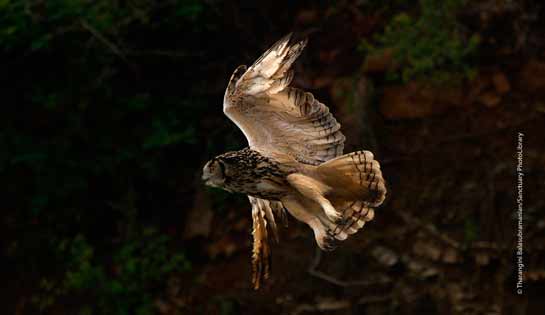 Photo: Tharangini Balasubramanian.
Once you hear its deep, resonant, hollow "bu-bo" call, you will be fascinated forever. The Indian Eagle Owl is also known as the Rock Horned Owl, Rock Eagle Owl, Bengal Eagle Owl and Great Horned Owl - the last term used by Dr. Sálim Ali and Ripley, but internationally accepted to be that of the American species Bubo virgianus.
Indian Eagle Owl Bubo bengalensis
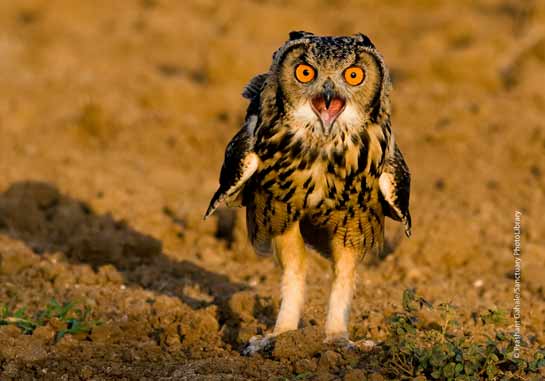 Photo: Prashant Gahale.
At one time the Indian Eagle Owl was considered a subspecies of the Eurasian Eagle Owl Bubo bubo, but molecular analysis has proved beyond doubt that it is a species in its own right. It does not cavity nest or build a nest, but chooses to lay its eggs in sheltered, bare areas.
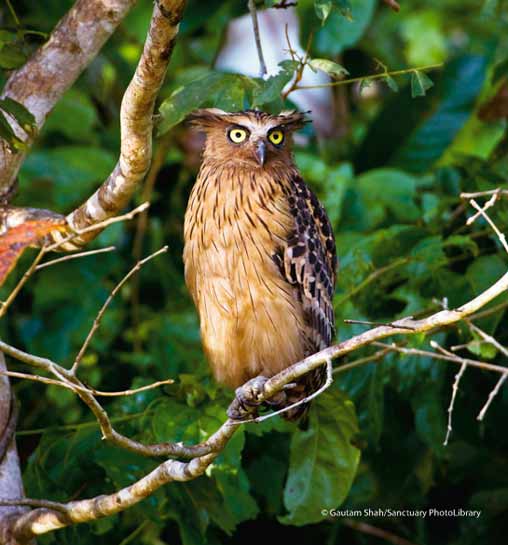
Buffy Fish-owl Ketupa ketupu
Photo: Gautam Shah.
It has brilliant yellowish eyes, a white patch above the bill and distinctive ear-tufts tilted at 45 degrees. Found along waterbodies in parts of south and Southeast Asia, it primarily eats fish, frogs and crustaceans though it may also prey on small mammals and birds. It looks quite similar to the Brown Fish Owl except for its darker feathers with thick black streaks. It roosts on trees during the day and begins hunting after dusk. The sharp spicules on the underside of the toes help it to hold on to slippery fish. Interestingly, this owl is not totally silent in flight as it lacks the soft fringes found along the rear-edges of the wing feathers of most other owl species.
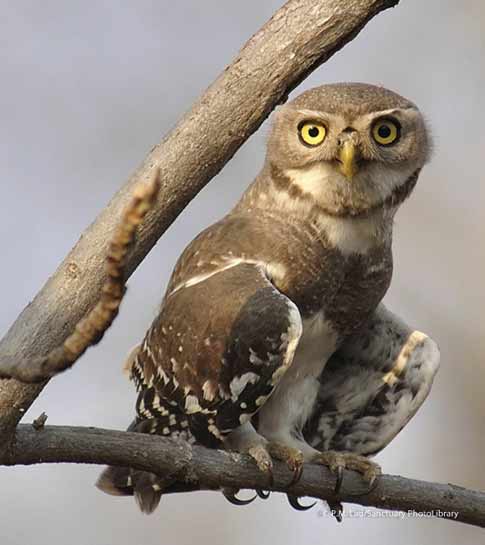
Forest Owlet Heteroglaux blewitti
Photo: P.M. Lad.
Thought to be extinct for almost 113 years, an American ornithologist Pamela Ramussen rediscovered the bird in the Satpura foothills in 1997. Since then others have located the Forest Owlet in nearby forests in southeast Madhya Pradesh and northern Maharashtra including the Melghat Tiger Reserve. There are estimated to be less than 250 birds and so it is critically endangered. The Forest Owlet is quite distinctive - it has white belly patches and prominent white markings on moustache and supercilium and its eyebrows give it a wise old man look. Its diet mainly consists of lizards, skinks and rodents though it may also prey on small birds.
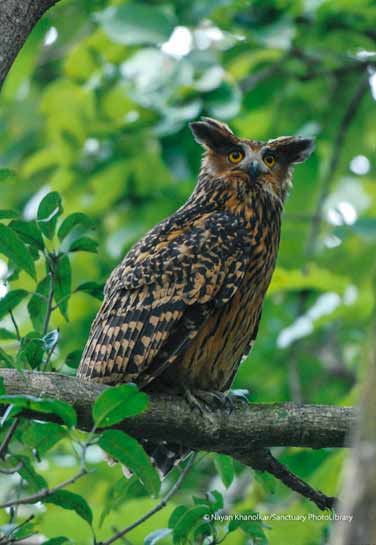
Tawny Fish-owl Ketupa flavipes
Photo: Nayan Khanolkar.
A large, powerful bird, this orange-brown coloured owl also has a white patch and white eyebrows with bushy ear tufts. The soles of its feet have prickly scales and the claws are large and curved with sharp-cutting edges. It lives along the river banks in Bangladesh, Bhutan, China, India, Laos and Vietnam where it feeds on fish, crustaceans, and small reptiles and mammals.
Jungle Owlet Glaucidium radiatuam
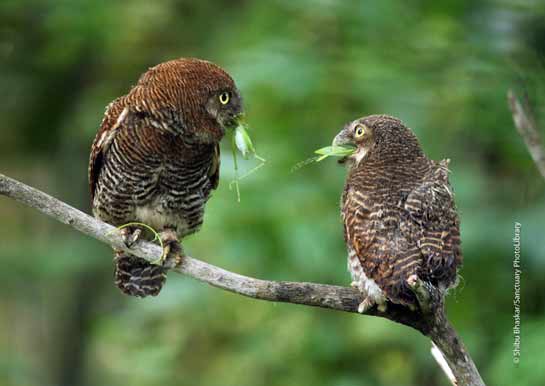 Photo: Shibu Bhaskar.
It is found in India and parts of Sri Lanka. It has a round head and little lines, like bars, across its body. This is why it is sometimes called the barred jungle owl. It lives in scrub, deciduous and moist deciduous forests where it is active mostly at dusk and dawn. Did you know that if you disturb this owl, it will freeze and pretend to be a dead tree stump? That's pretty intelligent!
Brown Fish-owl Ketupa zeylonensis
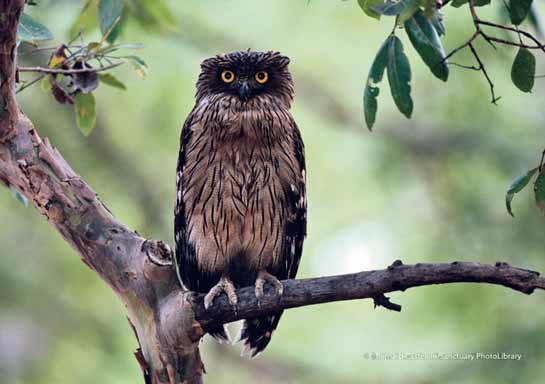 Photo: Bernard Castelein.
This large owl has big ear tufts and grows to around 22 inches long. The male is smaller than the female but otherwise they look similar. Both have red brown upperparts with black or dark brown streaks. The underparts are buff or white with more streaks and the throat is white. If you look closely, you will see that it has yellow irises which match its yellow feet!
Indian Scops-owl Otus bakkamoena
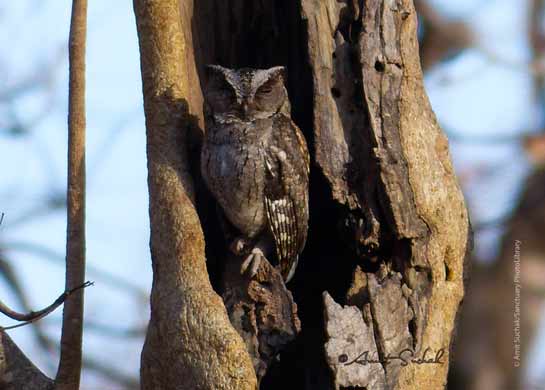 Photo: Amit Suchak.
This owl lives in several countries including Bangladesh, Cambodia, China, India, Indonesia and Japan. The colour of its feathers varies according to the area it is found in. It has black, brown streaks and white patches on its body. This owl roosts in thick vegetation by day. It mainly feeds on beetles and other insects. When the owl feels threatened, it will raise its ear tuft, stand very still, close its eyes and blend into the tree.
Spotted Owlet Athene brama
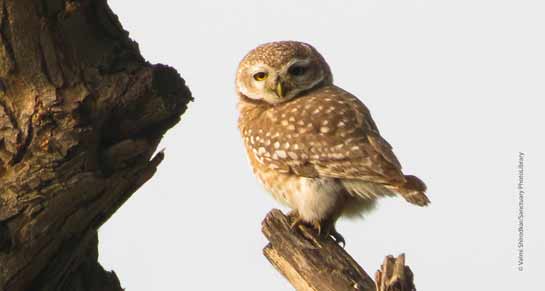 Photo: Valmi Shirodkar.
Small, just around 21 cm., brown and white speckles, yellow eyes, and white eyebrows, the Spotted Owlet is found from Iran to Southeast Asia. Like other owls, it feeds on a variety of prey ranging from insects to scorpions, rodents, toads and snakes. It nests in tree cavities or holes and lines them with leaves and feathers. A clutch consists of three to four eggs, which on hatching are fed insects such as cockroaches. If it gets scared, it sits and looks at the intruder while bobbing its head! That's pretty funny! It also has a distinctive call which goes chirurr-chirurr-chirurr ending with a chirwak-chirwak.
First appeared in: Sanctuary Asia Cub, November 2013.