The Three-Toed Sloth
Author:
First published in Sanctuary Asia,
Vol. 32
No. 11,
November 2012
On the ground, it is even slower and moves at around 250 m. per hour. It is really surprising how an animal that is so slow and has a weak sense of touch, sight and hearing survives in the wild. Interestingly it uses its weakness - slow movement - to its advantage.
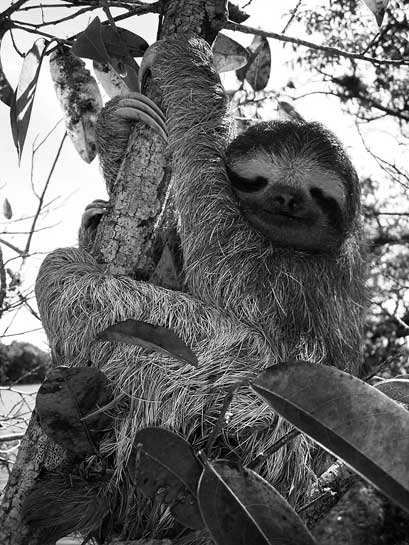
Its lack of movement and restful ways keep it out of notice of the big predators - jaguars, ocelots, Harpy Eagles and anacondas. It lies motionless even when awake and moves a little only at night, when it eats leaves and fruit. Further, its body hair contains algae that is brown in the summer and green during the wet season and helps the sloth camouflage perfectly with its surroundings. It has extra neck vertebrae that allows it to turn its head almost 2700. It depends on juicy plants for water and rarely, if ever comes down on land. Its hesitation to move on land is not surprising, given that it has weak hind legs and that it must dig into the ground with its front claws, drag its stomach across the ground and pull itself up using its front legs.

